Oneness Pentecostals are very difficult to pin down on their doctrine. They will profess something at one moment, and then vociferously deny it the next.
One thing that I have seen them assert is that the deity of Jesus is the Father in Heaven, while the Son was His humanity on earth. Therefore, the Son began with His conception in the womb of Mary. That means, depending on how you look at that assertion, that they either deny the deity of the Father, making Him Jesus instead, or they deny the deity of Jesus, making Him nothing more than a vessel for the Father. I should say that Oneness deny both of those implications. However, they also deny the applicability of logic to their doctrine. It is just "human reasoning," they claim. The principles of logic violated by their doctrines are the Law of Non-Contradiction, which states that a thing and its contrary cannot both be true at the same time and in the same way, and the Law of Identity, which states that a thing must be itself, not something else, again at the same time and in the same way.
In John 6:62, that apostle quotes these words of Jesus: "Then what if you were to see the Son of Man ascending to where He was before?" They apply very specifically to the matter at hand. Jesus says that He was in heaven before His incarnation. Oneness claim that this is a reference to His deity as the Father. However, He explicitly refers to Himself as the Son in this verse, not the Father. Here is where the laws of logic apply: Oneness deny the Law of Identity by making Him something other than what He is -and says that He is - to avoid the implications of this verse. And they violate the Law of Non-Contradiction by making Him the Son and the Father at the same time, in violation of their own doctrine. I should repeat, however, that these logical problems don't bother Oneness, because they consider logic to be "human reasoning."
In contrast, the Trinitarian violates neither rule. Since orthodox Christians hold that the Son has always been the Son, never the Father, both divine Persons keep their respective identities without contradiction. The Son was in Heaven from eternity as the Son. With Him was the Father, as the Father from eternity, just as we are told in John 1:1. Thus we maintain the full deity of both Father and Son, sacrificing neither in order to maintain a manmade doctrine.
Saturday, June 20, 2020


Wednesday, June 17, 2020
Because of Particular Atonement, No Charge Can be Laid Against the Elect
"Who shall bring any charge against God’s elect? It is God who justifies. Who
is to condemn? Christ Jesus is the one who died—more than that, who was
raised—who is at the right hand of God, who indeed is interceding for
us."
- Romans 8:33-34
The Christian should find great comfort in these verses. There is no one who can maintain a charge against God's elect. Why? Because he has been justified, and Christ Jesus intercedes for him before the throne of the Father. However, it is bad news for the reprobate, because there is no theanthropic Mediator in heaven for him.
These two verses provide a simple description of the doctrine of particular atonement. The believer has a mediator, while the unbeliever does not. The believer can take encouragement from the mediation of Jesus, but the unbeliever cannot.
"This purpose proceeding from everlasting love towards the elect, has from the beginning of the world to this day been powerfully accomplished, and will henceforward still continue to be accomplished, notwithstanding all the ineffectual opposition of the gates of hell, so that the elect in due time may be gathered together into one, and that there never may be wanting a church composed of believers, the foundation of which is laid in the blood of Christ, which may steadfastly love, and faithfully serve Him as their Savior, who as a bridegroom for His bride, laid down His life for them upon the cross, and which may celebrate His praises here and through all eternity" (Canons of Dordt, Head II, Article 9).
Saturday, June 13, 2020
The Sabbath in the Pre-Mosaic Period
Anti-Sabbatarians often argue that the Sabbath was part of the Mosaic ceremonial law, and was, therefore, abrogated by the incarnation, atoning work, and resurrection of Jesus. I addressed that argument in part here.
One of the reasons that I disagree with that argument is that the Sabbath was not created by Moses, unlike the actual ceremonies, such as the sacrifices or the priesthood. Rather, the Sabbath was a creation mandate, established by God in the creation period of Genesis: "On the seventh day, God finished His work that He had done, and He rested on the seventh day from all His work that He had done. So God blessed the Sabbath day and made it holy, because on it God rested from all His work that He had done in creation" (Genesis 2:2-3). Thus the Sabbath was not a Mosaic ritual, but was rather a creation mandate, just as marriage was.
Generally, the response I get is something to the effect of, "Then prove that anyone celebrated the Sabbath between the creation and Moses." There is so little thought put into that statement that it is obvious that they are merely repeating something that they have been told. The reason I don't believe that it is the result of study is that it is an argument from silence that cuts both ways: if I can't prove that people kept the Sabbath during that period, neither can the anti-Sabbatarian prove that they didn't. Additionally, even if the argument were correct, it is not to the point. The failure of the people to keep the commandment is not proof that the commandment was... Well, was what? Good advice? The anti-Sabbatarian doesn't say. They also don't say why failure to obey the land sabbaths didn't abrogate that law (Leviticus 26:45, II Chronicles 36:21).
Now lets fast-forward to Moses, in the receiving of the Ten Commandments. What we notice is that eight of the Commandments begin with "you shall" or "you shall not." The Fifth Commandment starts with"honor." However, only the Fourth Commandment begins with "remember." "Remember the Sabbath day, to keep it holy. Six days you shall labor, and do all your work, but the seventh day is a Sabbath to the Lord your God. On it you shall not do any work, you, or your son, or your daughter, your male servant, or your female servant, or your livestock, or the sojourner who is within your gates. For in six days the Lord made heaven and earth, the sea, and all that is in them, and rested on the seventh day. Therefore the Lord blessed the Sabbath day and made it holy" (Exodus 20:8-11). Remembering involves something that existed in time before our effort to remember it. The commandment even refers to the creation in its phrasing. Therefore, that one word proves that the Fourth Commandment wasn't creating the Sabbath; it was restoring it.
Wednesday, June 10, 2020
If God Has Determined All Things, Then Is He Responsible for Sin?
Let us be unequivocal: Scripture says that God has determined all things, from the beginning of the universe to eternity future. He Himself says, "I declare the end from the beginning and from ancient times things not
yet done, saying, ‘My counsel shall stand, and I will accomplish all My
purpose'" (Isaiah 46:10). We also read this: "Many are the plans in the mind of a man, but it is the purpose of the LORD that will stand" (Proverbs 19:21). Short of being deliberately obtuse, we cannot miss the meaning here. God has determined all things according to His own plan, not according to ours.
OK, so He has determined all things. Does He change course midway, whether because He has thought of a better way or because men have not approved of His plans? "Also the Glory of Israel will not lie or have regret, for He is not a man, that He should have regret" (I Samuel 15:29; see also Numbers 23:19). To claim that God would change His mind is to make Him like us, to bring Him down to man's level. And Scripture says that any such attempt is based on a false view of God.
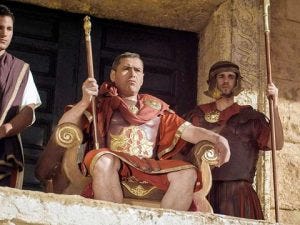
Then comes the question, what of the wicked acts of men? God could not have predetermined them, because that would make God responsible for sin, right? Well, no, not right. First, let us say that Scripture affirms that God has predetermined even the wicked acts of men: "Truly in this city [i. e., Jerusalem] there were gathered together against Your holy servant Jesus, whom You anointed, both Herod and Pontius Pilate, along with the Gentiles and the peoples of Israel, to do whatever Your hand and Your plan had predestined to take place" (Acts 4:27-28). So, in a prayer to God, Peter and John, while addressing God, confess that He had planned all of the events around the suffering and death of Jesus, even in planning the evil actions of Herod and Pilate. But what was the goal in those actions? The atonement of God's people. In other words, our salvation is dependent on God's predestining the evil actions of particular men!
Look also at Paul's words in Romans 3:7: "If through my lie God’s truth abounds to his glory, why am I still being condemned as a sinner?" Using the words of a hypothetical unbeliever, Paul has that unbeliever confess that his lies, his sins, glorify God. "However," the unbeliever pleads, "then I shouldn't be punished for them." The first part is true. His wickedness glorifies God, both through His justice to the unrepentant unbeliever and by His mercy to the repentant elect sinner. However, that wasn't the purpose when the sinner committed his wicked acts, just as Herod and Pilate planned nothing good by their murder of Jesus. That is why God is still just in bringing them under judgment. His bringing about good from their evil is to His praise, not theirs.
And it is also why God cannot be said to be the author of sin.
OK, so He has determined all things. Does He change course midway, whether because He has thought of a better way or because men have not approved of His plans? "Also the Glory of Israel will not lie or have regret, for He is not a man, that He should have regret" (I Samuel 15:29; see also Numbers 23:19). To claim that God would change His mind is to make Him like us, to bring Him down to man's level. And Scripture says that any such attempt is based on a false view of God.
Then comes the question, what of the wicked acts of men? God could not have predetermined them, because that would make God responsible for sin, right? Well, no, not right. First, let us say that Scripture affirms that God has predetermined even the wicked acts of men: "Truly in this city [i. e., Jerusalem] there were gathered together against Your holy servant Jesus, whom You anointed, both Herod and Pontius Pilate, along with the Gentiles and the peoples of Israel, to do whatever Your hand and Your plan had predestined to take place" (Acts 4:27-28). So, in a prayer to God, Peter and John, while addressing God, confess that He had planned all of the events around the suffering and death of Jesus, even in planning the evil actions of Herod and Pilate. But what was the goal in those actions? The atonement of God's people. In other words, our salvation is dependent on God's predestining the evil actions of particular men!
Look also at Paul's words in Romans 3:7: "If through my lie God’s truth abounds to his glory, why am I still being condemned as a sinner?" Using the words of a hypothetical unbeliever, Paul has that unbeliever confess that his lies, his sins, glorify God. "However," the unbeliever pleads, "then I shouldn't be punished for them." The first part is true. His wickedness glorifies God, both through His justice to the unrepentant unbeliever and by His mercy to the repentant elect sinner. However, that wasn't the purpose when the sinner committed his wicked acts, just as Herod and Pilate planned nothing good by their murder of Jesus. That is why God is still just in bringing them under judgment. His bringing about good from their evil is to His praise, not theirs.
And it is also why God cannot be said to be the author of sin.
Wednesday, June 3, 2020
Justification by Faith Can Never Be Justification for Sin
As an orthodox Protestant, I advocate and defend the doctrine of justification by faith alone as the standard against all false expressions of Christianity. And the consistent response from advocates of works righteousness is almost always that it means that a person can believe, and then live however wickedly he wants, and still be saved. They usually cite James 2:24 (an objection which I address here). I get this supposed trump-card most consistently from Mormons and Catholics.
Their claim is a caricature. Worse, it is a slogan, repeated from some apologetics book or class, not something thought through by the person making the accusation.
It is easy to refute. I have provided one such refutation in the link above. Another is found in the little epistle of Jude, especially verse 4: "Certain people have crept in unnoticed who long ago were designated for this condemnation, ungodly people, who pervert the grace of our God into sensuality and deny our only Master and Lord, Jesus Christ." Jude here describes people who profess to be Christians, but are then involved in some unspecified sin. But notice what else he tells us about them, that they are "condemned" as "ungodly." So, they do not have faith; they have a label. And that is a denial of Jesus, not faith.
This should be an indication to anyone who has been taught this as an argument against justification by faith that it is an accusation based on something that the Scriptures say is impossible. That means that the argument is false.
Then a far more important question should come to mind: If my religious teachers have taught me this falsehood, what are they trying to keep me from seeing as truth? They want to keep you from understanding justification by faith alone because that makes you dependent on Jesus alone, instead of them.
Saturday, May 30, 2020
What Happens to Children When They Die?
This is a hard topic on which to write. I anticipate some negative reaction. However, it is a question I have been asked repeatedly by anti-Calvinists.
First, let us look at the confessional standard: "Elect infants, dying in infancy, are regenerated and saved by Christ through the Spirit, who worketh when, and where, and how He pleaseth. So also are all other elect persons who are incapable of being outwardly called by the ministry of the Word" (Westminster Confession of Faith X:3). The divines described what happens to elect infants who die. Of course, since they are elect, that would be God's plan for them. What about non-elect infants? On that the divines were silent. Charles Hodge and his son, A. A. Hodge, took that to mean that all infants who die are elect. I think that is presumptuous, taking an argument from silence where it does not lead.
For the Christian, there is extensive biblical justification to believe that his dead child is in Heaven. First, God claims the children of believers for Himself in Ezekiel 16:20-21: "You took your sons and daughters, whom you had borne to Me, and these you sacrificed to them [i. e., idols] to be devoured. Were your whorings so small a matter that you slaughtered My children and delivered them up as an offering by fire to them?" When the Israelites had become so given over to idolatry that they even practiced human sacrifice, God's anger was directed at the theft of what belonged to Him by covenant.
And second, what does God promise to these children who are His? "Your children shall be taught by the LORD, and great shall be the peace of your children" (Isaiah 54:13). Also in Acts 2:39: "The promise is for you and for your children and for all who are far off, everyone whom the Lord our God calls to Himself." So, in both Testaments, we have a promise from God to be covenantally faithful to the children of believers. Is this a promise that every child of believers will be saved? No, it isn't, as we know both from personal experience and from the biblical examples of Esau and Ishmael.
However, we also have a biblical example of the comfort that covenantal promise is to the believer. When David's first son with Bathsheba died (II Samuel 12:15-23), David took comfort in his assurance that his son would be waiting for him is Heaven: "I shall go to him, but he will not return to me" (verse 23).
I think that the most-important verse on this issue is I Corinthians 7:14: "The unbelieving husband is made holy because of his wife, and the unbelieving wife is made holy because of her husband. Otherwise your children would be unclean, but as it is, they are holy." Paul tells us that the children of at least one Christian parent are holy. He doesn't say saved. Rather, he speaks of the covenantal connection between the believing parent and the child, such that the child is federally holy on the basis of the parent's faith.
However, we should notice his exact words. Paul speaks negatively. He doesn't just say, "The child with a believing parent is holy." Instead, he adds, that the child would otherwise be "unclean." And this is logical because we know there is no neutral moral state. But what are the consequences to the unbelieving parents regarding their own children?
"Nothing unclean will ever enter it [i. e., the New Jerusalem, v. 10], nor anyone who does what is detestable or false, but only those who are written in the Lamb’s book of life" (Revelation 21:27). Here is where the unbeliever must consider his standing with God, because it affects not just himself but also his children. If he decides that the pleasures of this life outweigh the eternal consequences, can he also say that they outweigh the eternal consequences for his child? Of course, this doesn't mean that every child of an unbeliever will himself be an unbeliever. We know from experience that the Holy Spirit often breaks into the families of unbelievers to bring one to Himself. I myself was such a convert. But the generality can be predicted, just as above with the children of believers.
This is my personal interpretation. Though I consider it a rational conclusion from the relevant Scriptures, I am aware that it goes beyond the confession. Therefore, other Calvinists should not be blamed for my personal opinion. I am especially conscious that I am going against some theological giants when I disagree with the Hodges. All I can say is that the Scriptures compel me.
Wednesday, May 27, 2020
The Limited Atonement of Arminianism
Arminians often accuse Calvinists of denying the atonement to some people by our biblical claim that it was particular. That is, we Calvinists follow the words of Jesus that He would die for those whom the Father had given Him, His friends, His sheep (John 6:37-39, etc.), or, in the words of Paul, for His Church (Ephesians 5:25). Yes, we believe that the Groom had the right and responsibility to love His Bride, not strange women (Proverbs 5:15).
However, in denying that biblical truth, the Arminian replaces it with an assertion that the atonement was universal, but only partial. That is, Jesus didn't necessarily die to save anyone. Rather, He died merely to make salvation possible.
However, the Arminian reads those same verses and blanks out the parts that refute him
So, I will ask these questions of the Arminian. Jesus tells us of men who will "die in their sins" (John 8:21). Then He mentions those whose "sin remains" (John 9:41). If Jesus died for the sins of all men, then why do these men still have sin when they die? Then the Arminian is forced to answer, "because they don't respond in faith." Ah, there it is: the Arminian limited atonement! Jesus died somewhat for all men, but that atonement is insufficient, until the man adds his assent.
So, when the Arminian thinks that he is morally superior because the Calvinist says that Jesus fully and effectually redeemed particular people, he is really suppressing his tacit claim that the atonement of his version of Jesus is so limited that it cannot save anyone without a little help from sinful men.
I deny that the Arminian doctrine is moral at all, much less more so that is the doctrine of Calvinism.
However, in denying that biblical truth, the Arminian replaces it with an assertion that the atonement was universal, but only partial. That is, Jesus didn't necessarily die to save anyone. Rather, He died merely to make salvation possible.
So, for what purpose did Jesus die: "She will bear a son, and you shall call His name Jesus, for He will save his people from their sins" (Matthew 1:21). Or, "He
himself bore our sins in His body on the tree, that we might die to sin
and live to righteousness. By His wounds you have been healed. For you were straying like sheep, but have now returned to the Shepherd and Overseer of your souls" (I Peter 2:24-25, cp. Isaiah 52:13-53:12). There are two things evident in these verses. First, that the blood of Jesus was intended to cleanse its objects from sins. And notice the pronouns that Peter uses, "our," "you," and "your." Those are particular pronouns, referring his comment to the audience of his epistle. Who was that? "To those who are elect exiles of the Dispersion in Pontus, Galatia, Cappadocia, Asia, and Bithynia, according
to the foreknowledge of God the Father, in the sanctification of the
Spirit, for obedience to Jesus Christ and for sprinkling with His blood: May grace and peace be multiplied to you. Blessed be the God and Father of our Lord Jesus Christ! According to His great mercy, He has caused us to be born again" (I Peter 1:1-3). Peter was speaking to Christians, not to non-Christians. And second, notice that there is no conditionality in these verses. There is no hemming and hawing about what men must do to make the atonement effectual. In fact, the Apostle even says that it is God who causes us to be born again.
However, the Arminian reads those same verses and blanks out the parts that refute him
So, I will ask these questions of the Arminian. Jesus tells us of men who will "die in their sins" (John 8:21). Then He mentions those whose "sin remains" (John 9:41). If Jesus died for the sins of all men, then why do these men still have sin when they die? Then the Arminian is forced to answer, "because they don't respond in faith." Ah, there it is: the Arminian limited atonement! Jesus died somewhat for all men, but that atonement is insufficient, until the man adds his assent.
So, when the Arminian thinks that he is morally superior because the Calvinist says that Jesus fully and effectually redeemed particular people, he is really suppressing his tacit claim that the atonement of his version of Jesus is so limited that it cannot save anyone without a little help from sinful men.
I deny that the Arminian doctrine is moral at all, much less more so that is the doctrine of Calvinism.
Subscribe to:
Posts (Atom)