Wednesday, March 29, 2017

Absolution: Purchased by Christ, Declared by a Minister, not Granted by a Priest

According to the Catholic Church, "Absolution proper is that act of the priest whereby, in the Sacrament of Penance, he frees man from sin." That is, a Catholic member can go to his priest, confess his sins, and receive forgiveness from that priest. Granted, the article goes on to explain, "It presupposes on the part of the penitent, contrition, confession, and promise at least of satisfaction; on the part of the minister, valid reception of the Order of Priesthood and jurisdiction, granted by competent authority, over the person
receiving the sacrament." Notice what is not mentioned: the satisfaction for sin in Jesus Christ on the cross. Thus, the source of forgiveness is the dispensation of the church organization, not by the Person and work of the Savior.

The Catholic doctrine is explained as an application of the words of Jesus (John 20:20-23): "When He had said this, He showed them His hands and His side. Then the disciples were glad when they saw the Lord. Jesus said to them again, 'Peace be with you. As the Father has sent Me, even so I am sending you.' And when He had said this, He breathed on them and said to them, 'Receive the Holy Spirit. If you forgive the sins of any, they are forgiven them; if you withhold forgiveness from any, it is withheld.'" This passage is from one of the post-resurrection appearances of Jesus. Therefore, it was after, and presupposes, His redemptive work in the crucifixion and resurrection. Therefore, He had already achieved what Paul describes in Romans 3:25: "Jesus Christ, whom God put forward as a propitiation by His blood, to be received by faith."

What that means is that Jesus wasn't giving an original power to the Apostles - much less to any church hierarchy - to forgive sins. Ministers, instead, have the authority to declare to the true believer what Jesus has done on his behalf (Romans 5:6): "While we were still weak, at the right time Christ died for the ungodly." If the person lacks faith, then any declaration by the minister is ineffectual (Matthew 10:13). It cannot save him apart from faith, not in the minister, but in Jesus Christ.

One may claim that there is no harm done by Rome to the person who understands the truth. And I would grant that (except, why then is he looking to a priest for absolution?). However, what about the person who doesn't understand? The harm is that he has been convinced to find his salvation in a man and the organization that man represents. And there can be none there! Rather, his only hope for absolution is by faith in the God-man who purchased that absolution on the cross two-thousand years ago. His conscience has been assuaged on a false basis, leaving him still in his sins! It is as if he has a cancer and thinks he has been cured by a sugar pill.

Monday, March 27, 2017

God Loves Us Too Much to Let Us Fall Away!

The doctrine of the perseverance of the saints is very precious to me. I know the wickedness of my own heart to be well-aware that I would reject all that I have in Jesus Christ and never look back. I will never understand those that object to it, as if they are such spiritual superheroes that their eternity is secure in their own power alone. There are also a lot of people who hold to some version of perseverance while rejecting the other doctrines of grace. That is nonsensical, too, pretending that I can get saved by my own free will, but then throwing it away for the rest of my earthly existence. A poisoned headwater can never produce a healthful stream!

A precious verse on the subject is Jeremiah 32:40: "I [God] will make with them an everlasting covenant, that I will never turn away from doing good to them. And I will put the fear of Me in their hearts, that they may not turn from Me."

Notice the carrot-and-stick approach God uses. He gives the positive incentive of His covenant, His unfailing promises. Then He adds the negative incentive of "fear." That is, He gives warnings of the consequences of apostasy, not because a true believer can ultimately fall away, but as a means of keeping us on the path. In fact, that provides the answer to the Arminians who repeatedly bring up such warnings as Hebrews 6:4-6 as supposed proof that the believer is not secure. The writer of Hebrews was demonstrating this principle from Jeremiah, of God's giving us fear so that we will not turn away from Him.

Saturday, March 25, 2017

Biblical Apologetics

"Since, in the wisdom of God, the world did not know God through wisdom, it pleased God, through the folly of what we preach, to save those who believe... Yet, among the mature, we do impart wisdom, although it is not a wisdom of this age or of the rulers of this age, who are doomed to pass away. But we impart a secret and hidden wisdom of God, which God decreed before the ages for our glory... And, even if our gospel is veiled, it is veiled to those are perishing. In their case, the god of this world has blinded the minds of the unbelievers, to keep them from seeing the light of the gospel of the glory of Christ, who is the image of God... [For] the natural person does not
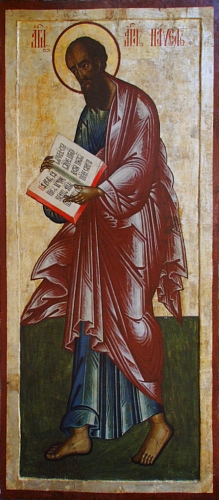
Paul Preaching
accept the things of the Spirit of God, for they are folly to him, and he is not able to understand them, because they are spiritually discerned
."
- I Corinthians 1:21, 2:4-5, II Corinthians 4:3-4, I Corinthians 2:14

The classical apologetics approach is to memorize lots of facts: biblical manuscripts, archeology, evolution, etc. These facts are intended to answer every conceivable objection that an unbeliever might have. It is based on an assumption that unbelief is a matter of ignorance, and that enough facts will convince the unbeliever to become a believer.

The problem is that there is no such indication in Scripture. When we read the Book of Acts, what answer do the evangelists give to their audiences? A list of facts, an expectation that there is a common ground from which an unbeliever can be led to belief? Not even once. Rather, the Apostles always answered with Scripture.

In the verse I quote above from the two epistles to the Corinthians, what does Paul tell us about the process of apologetics? He tells us that God didn't choose bald facts as the means to convert the unbeliever. Rather, He chose the folly of preaching (see also Romans 10:13-21). That's because belief doesn't come from an exercise of intellect. Unbelievers already know about God (Romans 1:18). Paul made that same point when he pointed out the altar to "the unknown god" in Athens (Acts 17:23). The problem isn't a lack of information, but rather that they hate God and the knowledge that they are answerable to Him. The problem for the unbeliever isn't ignorance but unbelief (Romans 8:7)!

What is the nature of the unbeliever that is addressed by the apologist? It is that Satan has blinded him, not to knowledge, but to consequences. It is only the Holy Spirit, not a list of facts, that can tear away that willful blindness, because spiritual truth isn't understood as bald facts, but as a spiritual revelation.

Wednesday, March 22, 2017

What Is a Sin unto Death?

In I John 5:16, the Apostle says something odd: "If anyone sees his brother committing a sin not leading to death, he shall ask, and God will give him life—to those who commit sins that do not lead to death. There is sin that leads to death; I do not say that one should pray for that." Three times in the one verse, John refers to a sin that leads to death. The interpretation of that phrase is one that has divided biblical Christians throughout history.

John Calvin says, "I have already said that the sin to which there is no hope of pardon left, is thus called. But it may be asked, what this is; for it must be very atrocious, when God thus so severely punishes it. It may be gathered from the context, that it is not, as they say, a partial fall, or a transgression of a single commandment, but apostasy, by which men wholly alienate themselves from God. For the Apostle afterwards adds, that the children of God do not sin, that is, that they do not forsake God, and wholly surrender themselves to Satan, to be his slaves. Such a defection, it is no wonder that it is mortal; for God never thus deprives his own people of the grace of the Spirit; but they ever retain some spark of true religion.
The Apostle John
They must then be reprobate and given up to destruction, who thus fall away so as to have no fear of God." And, to an extent, I agree with him. The apostate is condemned. the problem with that is that no man knows whether another is finally apostate, until that person is dead, so that he has no opportunity for repentance. Until then, the Christian has good reason to pray that God would restore the man who has lapsed from his profession. Therefore, I cannot accept that Calvin is correct here.

It is commonly held that John is referring to the blasphemy of the Holy Spirit (Matthew 12:31). And I grant that is a plausible interpretation, because it is the only sin described in Scripture for which there is no forgiveness. I could see Calvin's interpretation in this case. However, I'm not sure that solves our problem, because Jesus didn't explain what constitutes blasphemy against the Holy Spirit, yet it is something that John considers discernible to his audience. Furthermore, since John was present when Jesus made that declaration, why didn't he use the words of Jesus, if that is the sin that he meant? So, while I agree that this interpretation is possible, I do not see it as probable.

My personal opinion is that John is referring neither to ultimate apostasy nor the blasphemy of the Holy Spirit (which are probably the same thing). Rather, I think he means those sins that make the perpetrator subject to capital punishment, such as murder. That is, John expects Christians to support the godly social order, not to expect God to undermine lawful justice. he is repeating a concept of Moses's: "If a man has committed a crime punishable by death and he is put to death, and you hang him on a tree, his body shall not remain all night on the tree, but you shall bury him the same day, for a hanged man is cursed by God. You shall not defile your land that the Lord your God is giving you for an inheritance" (Deuteronomy 21:22-23). That land is polluted by the tolerance of heinous wickedness, and it is the responsibility of the godly man to work for, and to maintain, God's justice as the means of removing that pollution.

Monday, March 20, 2017

"Everlasting Father" and "Father of Nations"


A major weakness of Modalism is the habit of its followers to take one isolated verse and interpret the rest of Scripture through that one verse. For example, they cite Acts 2:38 and subordinate all of the biblical references to justification by faith to their interpretation of that one verse. In the same way, they claim that Jesus is the incarnation of the Father on the basis of one reference, Isaiah 9:6: "For to us a Child is born, to us a Son is given; and the government shall be upon His shoulder, and His name shall be called Wonderful Counselor, Mighty God, Everlasting Father, Prince of Peace." If you challenge them to produce a place that names Jesus "the Father," this is the only one they can produce. 

I will certainly grant that the verse does refer to Jesus, and describes the ministry He was to have as the only Mediator between God and men (I Timothy 2:5). However, I deny vehemently that it says or implies that He was to be God the Father in the flesh.

First, the titles in the verse refer to various offices that the Messiah would hold. He would be a Wonderful Counselor. To whom? To us. He would be Mighty God. To whom? To us. He would be the Prince of Peace. To whom? To us. He would also be an Everlasting Father. To whom? Not to us, the Modalist claims, but to Himself. To do such violence to grammar is a sign of a false hermeneutic. Modalists will talk about the importance of context in understanding Scripture, while yet committing this brazen act of ripping two words out of the context of their very sentence!

In contrast, Abraham is called "father of nations" repeatedly, in both the Old and New Testaments. For example, the phrase is applied to him three times in Genesis 17:4-6. That's three times in three verses! Paul refers to him as "father of nations" twice in Romans 4:17-18. So, five times in just five verses, in both testaments. So, if anyone does, I would think that Abraham has a better claim to being the incarnate Father than Jesus does. After all, Jesus is called "Father" in just one verse, and never in the New Testament. Challenged to show any place where Jesus refers to Himself, or is referred to by any of the Apostles, as "Father," the Modalist will only respond with steely silence.

Saturday, March 18, 2017

Men and the Politics of Abortion

"David therefore sought God on behalf of the child. And David fasted and went in and lay all night on the ground. And the elders of his house stood beside him, to raise him from the ground, but he would not, nor did he eat food with them. On the seventh day the child died. And the servants of David were afraid to tell him that the child was dead, for they said, 'Behold, while the child was yet alive, we spoke to him, and he did not listen to us. How then can we say to him the child is dead? He may do himself some harm.' But when David saw that his servants were whispering together, David understood that the child was dead. And David said to his servants, 'Is the child dead?' They said, 'He is dead.' Then David arose from the earth and washed and anointed himself and changed his clothes. And he went into the house of the Lord and worshiped. He then went to his own house. And when he asked, they set food before him, and he ate. Then his servants said to him, 'What is this thing that you have done? You fasted and wept for the child while he was alive; but when the child died, you arose and ate food.' He said, While the child was still alive, I fasted and wept, for I said, 'Who knows whether the Lord will be gracious to me, that the child may live?'"
- II Samuel 12:16-22

These verses are from the passage that describes David's sin with Bathsheba. He had seen her bathing and desired for himself, even though she was a married woman. He got her pregnant, and tried to arrange circumstances that would make it appear that her husband was the true father, a scheme which failed. That husband, Uriah, was in the army, and David arranged to have him killed. Thus, David compounded the sin of lust with adultery and then with murder. Horrific under any circumstances, but especially in God's anointed king over His people..

After Uriah was killed, David took Bathsheba into his palace, where she gave birth to a son. However, God was displeased, and the infant died.

I see this as applying to our own day in the holocaust of abortion. So many men are impregnating women who aren't their wives. Then they are avoiding responsibility for those women and their children by sending them to the abortionists. Where David murdered the husband of the object of his lust, today's men murder the babies who are victims of their lust. Victimized women, compounded with victimized children, and the men avoid any accountability. In the story of David and Bathsheba, David accepted responsibility for his sins. Today's men rarely do.

Wednesday, March 15, 2017

Jesus on the Doctrines of Grace


When discussing the so-called Five Points of Calvinism, people tend to focus on the writings of Paul. that is hardly surprising, since he develops those doctrines much more than any other biblical author. however, he does not have exclusive claim on them.

Sometimes we forget that Jesus Himself taught about the doctrines of grace.

"'What must we do, to be doing the works of God?' Jesus answered them, “This is the work of God, that you believe in Him whom He has sent.' So they said to Him, 'Then what sign do You do, that we may see and believe You? What work do you perform? Our fathers ate the manna in the wilderness; as it is written, "He gave them bread from heaven to eat."' Jesus then said to them, 'Truly, truly, I say to you, it was not Moses who gave you the bread from heaven, but My Father gives you the true bread from heaven. For the bread of God is He who comes down from heaven and gives life to the world.' They said to Him, 'Sir, give us this bread always.'"
- John 6:28-34

Here we see effectual calling, an aspect of irresistible grace. It is not the will of men to believe. Rather, it is something that God causes us to do. That's why Paul says, "So then it depends not on human will or exertion, but on God, who has mercy" (Romans 9:16).

"Jesus said to them, 'I am the bread of life; whoever comes to Me shall not hunger, and whoever believes in Me shall never thirst. But I said to you that you have seen Me and yet do not believe. All that the Father gives me will come to Me, and whoever comes to Me I will never cast out. For I have come down from heaven, not to do My own will but the will of Him who sent Me. And this is the will of Him who sent Me, that I should lose nothing of all that He has given Me, but raise it up on the last day. For this is the will of My Father, that everyone who looks on the Son and believes in Him should have eternal life, and I will raise him up on the last day.'
- John 6:35-40

This section shows particular atonement ("all that the Father gives me"), irresistible grace ("will come to Me"), and perseverance of the saints ("I will lose nothing").

"So the Jews grumbled about Him, because He said, 'I am the bread that came down from heaven.' They said, 'Is not this Jesus, the son of Joseph, whose father and mother we know? How does He now say, "I have come down from heaven"?' Jesus answered them, 'Do not grumble among yourselves. No one can come to Me unless the Father who sent Me draws him. And I will raise him up on the last day.'"
- John 6:41-44

And here we see reprobation ("no one can come to Me unless the Father draws Him").

Thus, in this one passage, John 6:31-44, Jesus teaches irresistible grace, particular atonement, perseverance of the saints, and reprobation (though not one of the big five). And his assertion that the saved will be those whom the Father has given Him is a description of unconditional election. Twice! The only one not here is total depravity.

I cannot see any alternative to the probability that the failure to see the doctrines associated with Calvinism is no accident, but rather deliberate blindness, which Jesus also talks about: "Seeing they do not see, and hearing they do not hear, nor do they understand" (Matthew 13:13).