In Scripture, we are commanded to honor Christ by "always being prepared to make a defense to anyone who asks you for a reason for the hope that is in you" (I Peter 3:15). Any time a Christian explains to an unbeliever why he believes what he does, then he is fulfilling this command. However, there are also formal responses to this command, leading to the theological school called "apologetics." That doesn't refer to "apologizing," though it comes from the same Greek word. Rather, it simply means "defense," that is, defending what one believes. Or, to use the definition of Theologian John Frame, apologetics is the application of Scripture to unbelief. In Christian apologetics, there are a number of schools of apologetics, but the two predominant schools are the evidentialist (also called "Thomist," after the most famous apologist of this school, St. Thomas Aquinas, though there are many non-Thomist shades, as well), and the presuppositionalist.
The primary difference falls in what the proper basis is for that defense. The evidentialist, as the name suggests, holds that the Christian should use the common grounds of logic and empirical evidence to convince the unbeliever of Christian truth. The presuppositionalist holds that one must presuppose the truth of the Bible and the triune God in order for logic and proofs to have a rational basis. Thus, the presuppositionalist denies that a believer and an unbeliever have common ground from which to work toward God's truth. For a more-detailed account of the differences, one can look here and here.
I hold to the presuppositionalist approach. As I have noted before, the Apostles never tried to prove the existence of God or the truth of the Bible.When the evidentialist claims to seek "neutral ground," i. e., not bringing any assumptions apart from those shared by the unbeliever, then he is endorsing the autonomy of the unbeliever. In other words, the supposed "neautral ground" claimed by the evidentialist is no such thing, but rather to argue from the assumption of autonomy that is the fundamental error of the unbeliever. The "neutral ground" is actually the ground of unbelief. How can a Christian apologist argue his case from the basis of unbelief?
In addition to Paul's sermon on the Areopagus (Acts 17:16-34), I look at his words in I Corinthians 2:1-5: "And I, when I came to you, brothers, did not come proclaiming to you the testimony of God with lofty speech or wisdom. For I decided to know nothing among you except Jesus Christ and Him crucified. And I was with you in weakness and in fear and much trembling, and my speech and my message were not in plausible words of wisdom, but in demonstration of the Spirit and of power, so that your faith might not rest in the wisdom of men but in the power of God." Notice how he describes his evangelistic ministry among the Corinthians: he declared Christ crucified; he did not try to appeal to their natural wisdom with logical arguments and secular proofs. I also consider the words of the Apostle John, in I John 5:9-11: "If
we receive the testimony of men, the testimony of God is greater, for
this is the testimony of God that He has borne concerning His Son. Whoever
believes in the Son of God has the testimony in himself. Whoever does
not believe God has made Him a liar, because he has not believed in the
testimony that God has borne concerning His Son. And this is the testimony, that God gave us eternal life, and this life is in His Son." Unbelief is a lie, not because it doesn't understand the argument from first cause, but because it denies the testimony that God has given of His Son. That is the point of conflict, not any imaginary common ground.
Lastly, consider Paul's words, again, this time from Romans 1:18-22: "The wrath of God is revealed from heaven against all ungodliness and
unrighteousness of men, who by their unrighteousness suppress the truth. For what can be known about God is plain to them, because God has shown it to them. For His invisible attributes, namely, His eternal power and divine nature,
have been clearly perceived, ever since the creation of the world, in the things that have been made. So they are without excuse. For
although they knew God, they did not honor Him as God or give thanks to Him, but they became futile in their thinking, and their foolish hearts
were darkened. Claiming to be wise, they became fools." Note what he says, that the unbeliever is not ignorant of the truth of the biblical God, but rather has suppressed what he already knows is true. Thus, the error of the evidentialist is in failing to understand the point of conflict: it is not over evidence, but over right versus wrong will. And that must be the point at which the apologist directs the truth of God.
Saturday, May 28, 2016


Saturday, May 21, 2016
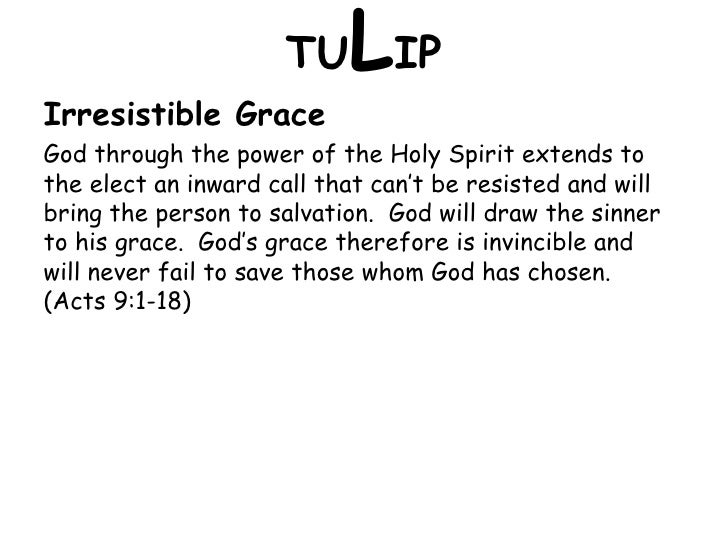
Irresistible Grace: What a Blessing!
 |
| The textbook definition |
One such nugget is subtle, hidden, easily passed over in our rush to get through such an unspiritual book. It is II Chronicles 20:6, in which Judean King Jehoshaphat prays, "O Lord, God of our fathers, are You not God in heaven? You rule over all the kingdoms of the nations. In Your hand are power and might, so that none is able to withstand You."
This verse is an Arminian's nightmare. In debates with Arminians, they consistently claim that God gives man "free will," that is, a natural ability to choose spiritual good or evil (a heresy called semi-Pelagianism), and that He is duty-bound to honor our free-will choices. Never do they produce Scriptural evidence for either such free will or for God's responsibility to hold His plans in abeyance for it.
In contrast, the Chronicler (we don't know the identity of the human author of First and Second Chronicles) describes, under the inspiration of the Holy Spirit, the sovereignty of God, not just over the willing, but over all! In theology, this is referred to as "irresistible grace." "Irresistible" isn't intended to mean that God conks us over the head, to drag us to do His will. Such a caricature (as one will often hear from Arminians) misrepresents the relationship of believer to God. Rather, God changes our will (Philippians 2:13), so that we then choose to carry out His intent freely. Apart from that act of grace, there is no such will (Romans 3:11-12). We also find this principle in the prophets, e. g., Ezekiel 35:26-27: "I will give you a new heart, and a new spirit I will put within you. And I will remove the heart of stone from your flesh and give you a heart of flesh; and I will put My Spirit within you, and cause you to walk in My statutes and be careful to obey My rules" [emphasis added]. Notice the verbs in that passage. They indicate the effectual initiative of God, which produces His intended change is us. In none of them do we see an indication that the object of His grace initiates or chooses that change. See also what I have written here.
I know my own heart. At least, I know it as well as any man can know himself. I am conscious every moment that my own spiritual strength would fail if left to its own freedom. I glory in one thing only, and that is the irresistible grace of God, by which He made me His own child, and sustains me, as such, every moment that I am in this fallen world. Why do so many people hate that truth, when it brings me such comfort?
Saturday, May 14, 2016
The Continuing Sabbath Is the First-Day Sabbath in the Christian Dispensation
As I have said before (use the "sabbath" tag at the bottom of this post), I hold to the traditional view of
 Sunday as the Christian Sabbath, binding on Christians just as - though in a non-legalist fashion - on the Jews under the Old Covenant.
Consider the juxtaposition of these two Scriptures.
In Deuteronomy 23:1, we read, "No one whose testicles are crushed or whose male organ is cut off shall enter the assembly of the LORD." My apologies for the indelicacy here, but this refers to eunuchs. They were denied membership in the covenant community. However, add the prophecy from Isaiah 56:4-5: "Thus says the Lord: To the eunuchs who keep my Sabbaths, who choose the things that please me and hold fast my covenant, I will give in my house and within my walls a monument and a name better than sons and daughters; I will give them an everlasting name that shall not be cut off."
Those two verses should create a certain dissonance in our minds. We have the same group excluded from the covenant community in one verse promised covenant blessings in another. The fulfillment of that could only come under the New Covenant.
The significance of that applies much more widely than just to the few people in the world who have been castrated. It indicates a Sabbath blessing that can only be to Christians in the Gospel dispensation.
To my mind, this is further - not the only - evidence that the Fourth Commandment has not been abrogated for Christians.
Thus, I again endorse as true what is said in the Westminster Confession of Faith (XXI:7): "As it is of the law of nature, that, in general, a due proportion of time be set apart for the worship of God; so, in his Word, by a positive, moral, and perpetual commandment, binding all men in all ages, he hath particularly appointed one day in seven for a Sabbath, to be kept holy unto him: which, from the beginning of the world to the resurrection of Christ, was the last day of the week; and, from the resurrection of Christ, was changed into the first day of the week, which in Scripture is called the Lord's Day, and is to be continued to the end of the world as the Christian Sabbath."
Consider the juxtaposition of these two Scriptures.
In Deuteronomy 23:1, we read, "No one whose testicles are crushed or whose male organ is cut off shall enter the assembly of the LORD." My apologies for the indelicacy here, but this refers to eunuchs. They were denied membership in the covenant community. However, add the prophecy from Isaiah 56:4-5: "Thus says the Lord: To the eunuchs who keep my Sabbaths, who choose the things that please me and hold fast my covenant, I will give in my house and within my walls a monument and a name better than sons and daughters; I will give them an everlasting name that shall not be cut off."
Those two verses should create a certain dissonance in our minds. We have the same group excluded from the covenant community in one verse promised covenant blessings in another. The fulfillment of that could only come under the New Covenant.
The significance of that applies much more widely than just to the few people in the world who have been castrated. It indicates a Sabbath blessing that can only be to Christians in the Gospel dispensation.
To my mind, this is further - not the only - evidence that the Fourth Commandment has not been abrogated for Christians.
Thus, I again endorse as true what is said in the Westminster Confession of Faith (XXI:7): "As it is of the law of nature, that, in general, a due proportion of time be set apart for the worship of God; so, in his Word, by a positive, moral, and perpetual commandment, binding all men in all ages, he hath particularly appointed one day in seven for a Sabbath, to be kept holy unto him: which, from the beginning of the world to the resurrection of Christ, was the last day of the week; and, from the resurrection of Christ, was changed into the first day of the week, which in Scripture is called the Lord's Day, and is to be continued to the end of the world as the Christian Sabbath."
Saturday, May 7, 2016
Repentance Is Not Optional
I have noticed an attitude among Christians that says that repentance is a good thing, but nothing more. One can repent, or not, as he sees fit. It has become more of a matter of feelings. That is, if a sinful act has brought feelings of guilt, then repent, so you can feel better about yourself. But that is certainly not a biblical view of repentance.
First of all, repentance is a command, not a suggestion. Consider Acts 17:30: "[God] commands all people everywhere to repent." From Whom does the command originate? From God. To whom is it directed? To all, man, woman, and child, whether professing Christian or not. And people where? Everywhere, i. e., in every nation, of whatever culture. And the logic is compelling. Since every human being (Jesus excepted, of course) is a sinner (Romans 3:23), without regard to age (Psalm 51:5), and is under judgment for that sin (Romans 6:23), there is no human being (again excepting Jesus) who is not in need of repentance.See also Luke 24:47.
However, since we are sinners, we are incapable of any spiritual good (Isaiah 64:6, Romans 3:10-12). That is because sin has killed us, spiritually speaking (Ephesians 2:1). That leaves us without the ability to fulfill this command out of our mere will to do so. In fact, it is impossible for us to will to do so. Rather, it is necessary for God to change our wills (Philippians 2:13). When He does so, then He enables the regenerate sinner to repent of sin (Acts 5:31, II Timothy 2:25). What a wonder that is, that He creates in us the thing that He demands from us!

But the amazement continues: when He grants repentance to the sinner, there is celebration, both on earth and in heaven. When men see a sinner repent, they give glory to God for His grace (Acts 11:18). And in heaven, even the angels celebrate (Psalm 89:5, Luke 15:10).
In writing this, my hope is that someone, somewhere, feeling the oppression of his sin, will answer the Lord's command to repent, turn to Jesus for the forgiveness of that sin, that I and the angels may celebrate! My email address is in the panel to the right. I hope that someone will write me to tell of that experience. But, even if you don't, I hope that you will receive and experience this gift of God, and know that the angels in heaven celebrate with you.
Someone may be saying that he doesn't understand what repentance is. I will give you an historical answer, question 87 from the Westminster Shorter Catechism, one of the doctrinal documents used in Presbyterian churches: "What is repentance unto life? Repentance unto life is a saving grace, whereby a sinner, out of a true sense of his sin, and apprehension of the mercy of God in Christ, doth, with grief and hatred of his sin, turn from it unto God, with full purpose of, and endeavour after, new obedience."
First of all, repentance is a command, not a suggestion. Consider Acts 17:30: "[God] commands all people everywhere to repent." From Whom does the command originate? From God. To whom is it directed? To all, man, woman, and child, whether professing Christian or not. And people where? Everywhere, i. e., in every nation, of whatever culture. And the logic is compelling. Since every human being (Jesus excepted, of course) is a sinner (Romans 3:23), without regard to age (Psalm 51:5), and is under judgment for that sin (Romans 6:23), there is no human being (again excepting Jesus) who is not in need of repentance.See also Luke 24:47.
However, since we are sinners, we are incapable of any spiritual good (Isaiah 64:6, Romans 3:10-12). That is because sin has killed us, spiritually speaking (Ephesians 2:1). That leaves us without the ability to fulfill this command out of our mere will to do so. In fact, it is impossible for us to will to do so. Rather, it is necessary for God to change our wills (Philippians 2:13). When He does so, then He enables the regenerate sinner to repent of sin (Acts 5:31, II Timothy 2:25). What a wonder that is, that He creates in us the thing that He demands from us!
But the amazement continues: when He grants repentance to the sinner, there is celebration, both on earth and in heaven. When men see a sinner repent, they give glory to God for His grace (Acts 11:18). And in heaven, even the angels celebrate (Psalm 89:5, Luke 15:10).
In writing this, my hope is that someone, somewhere, feeling the oppression of his sin, will answer the Lord's command to repent, turn to Jesus for the forgiveness of that sin, that I and the angels may celebrate! My email address is in the panel to the right. I hope that someone will write me to tell of that experience. But, even if you don't, I hope that you will receive and experience this gift of God, and know that the angels in heaven celebrate with you.
Someone may be saying that he doesn't understand what repentance is. I will give you an historical answer, question 87 from the Westminster Shorter Catechism, one of the doctrinal documents used in Presbyterian churches: "What is repentance unto life? Repentance unto life is a saving grace, whereby a sinner, out of a true sense of his sin, and apprehension of the mercy of God in Christ, doth, with grief and hatred of his sin, turn from it unto God, with full purpose of, and endeavour after, new obedience."
Saturday, April 30, 2016
Each Day the Unbeliever Builds Up the Wrath of God Against Himself
While the unbeliever justifies himself every day, with his professions that "there is no proof for God," each breath he draws, each draft of water he drinks, and every crumb of food he consumes comes as a gift from God.

In Romans 2:4-5, the Apostle Paul asks us, "Do you presume on the riches of his kindness and forbearance and patience, not knowing that God’s kindness is meant to lead you to repentance? But because of your hard and impenitent heart you are storing up wrath for yourself on the day of wrath when God’s righteous judgment will be revealed."
That is a stark warning! God gives each of His creatures the gifts of life (Matthew 5:45). Yet the unbeliever not only refuses to thank Him for His gifts but even denies Him who has provided these gifts. How can God not be offended by such abuse? Or that of the idol-worshiper who attributes God's gifts to some demon, whether he calls it Mary or Ganesh or Allah? If a human father were to give a gift to his son, and that son were to respond by spitting in his face and running to thank some passing stranger, would that father not feel abused?
In Psalm 103:10, David tells us, "He does not deal with us according to our sins, nor repay us according to our iniquities." Centuries later, the priest Ezra repeated those words (Ezra 9:13): "You, our God, have punished us less than our iniquities deserved." They pointed to a simple truth: our sins deserve eternity in Hell because they are acts of rebellion against our eternal Creator and Lord. Therefore, every moment we spend outside Hell is a gift from God.
These are the gifts of God: our existence (Acts 17:28), our daily sustenance (Matthew 5:45), and our daily experience of His mercy (Psalm 103:10). Why does He grant them to us? That they may inspire us to turn to him in repentance. It is much like when a man waves a bit of food to entice a wild animal to approach and eat from his hand. But unbelief is like such an animal biting, not the gift, but the hand of the giver. In an unthinking animal, such a reaction can be understood, but in a rational human being it is an act of evil.
However, as long as a man draws breath, repentance is available to him. To every person who acknowledges his rebellion and turns to his King for pardon, that King, God, extends this invitation (Isaiah 55:1-3):
"Come, everyone who thirsts,
come to the waters;
and he who has no money,
come, buy and eat!
Come, buy wine and milk
without money and without price.
Why do you spend your money for that which is not bread,
and your labor for that which does not satisfy?
Listen diligently to Me, and eat what is good,
and delight yourselves in rich food.
Incline your ear, and come to Me;hear, that your soul may live."
Saturday, April 23, 2016
The Bride of Christ as Proof of His Deity
In Isaiah 54:5, we read, "Your Maker is your husband, the LORD of hosts is His name; and the Holy
One of Israel is your Redeemer, the God of the whole earth He is called." This verse comes right after the Prophet's beautiful description of the suffering and humiliation of Christ as the basis for our justification. This verse appears right after it because it is the Father, in the intra-Trinitarian covenant, who decreed that this would be that the church would be saved from the judgment earned by our sins.
Yet we read of the marriage supper in Revelation 19:7-8: "Let us rejoice and exult and give Him the glory, for the marriage of the Lamb has come, and His Bride has made herself ready; it was
 granted her to clothe herself with fine linen, bright and pure' — for the fine linen is the righteous deeds of the saints." Here is the Bride of Christ, explicitly identified with the "saints," that is, believers.
And, again, consider Revelation 21:2, 9-11, "I saw the holy city, new Jerusalem, coming down out of heaven from God, prepared as a bride adorned for her husband. Then came one of the seven angels who had the seven bowls full of the seven last plagues and spoke to me, saying, 'Come, I will show you the Bride, the wife of the Lamb.' And he carried me away in the Spirit to a great, high mountain, and showed me the holy city Jerusalem coming down out of heaven from God, having the glory of God, its radiance like a most rare jewel, like a jasper, clear as crystal." The church is again identified, this time by the epithet "the New Jerusalem" (compare Hebrews 12:22), as the Bride.
As most people are aware, one of the distinguishing doctrines of the Jehovah's Witnesses is their Arianism, that is, the belief that Christ is not to be identified with God, but is, rather, a lesser, created being. These verses directly counter that error. In Isaiah, it is Jehovah (the LORD) who is the husband of the church. In Revelation it is the Lamb, i. e., Jesus Christ (see, for example, John 1:29). Since no bride can have two husbands, then the transitive principle tells us that these two Grooms must be the same being: Jesus is Jehovah in the flesh!
Yet we read of the marriage supper in Revelation 19:7-8: "Let us rejoice and exult and give Him the glory, for the marriage of the Lamb has come, and His Bride has made herself ready; it was
And, again, consider Revelation 21:2, 9-11, "I saw the holy city, new Jerusalem, coming down out of heaven from God, prepared as a bride adorned for her husband. Then came one of the seven angels who had the seven bowls full of the seven last plagues and spoke to me, saying, 'Come, I will show you the Bride, the wife of the Lamb.' And he carried me away in the Spirit to a great, high mountain, and showed me the holy city Jerusalem coming down out of heaven from God, having the glory of God, its radiance like a most rare jewel, like a jasper, clear as crystal." The church is again identified, this time by the epithet "the New Jerusalem" (compare Hebrews 12:22), as the Bride.
As most people are aware, one of the distinguishing doctrines of the Jehovah's Witnesses is their Arianism, that is, the belief that Christ is not to be identified with God, but is, rather, a lesser, created being. These verses directly counter that error. In Isaiah, it is Jehovah (the LORD) who is the husband of the church. In Revelation it is the Lamb, i. e., Jesus Christ (see, for example, John 1:29). Since no bride can have two husbands, then the transitive principle tells us that these two Grooms must be the same being: Jesus is Jehovah in the flesh!
Saturday, April 16, 2016
The Proper Mode of Baptism: Sprinkling
The Westminster Confession of Faith (the primary doctrinal formulation of Presbyterian Churches), says in XXVIII:3, "Dipping of the person into the water is not necessary; but baptism
is rightly administered by pouring or sprinkling water upon the person." This is in opposition to Baptists and other Christians who insist that immersion (called "dipping" here) is the only legitimate mode of baptism. They claim that the word "baptism" means "immersion." I have addressed that particular claim here. By this statement, the divines were not saying that one cannot be baptized by immersion. In fact, I was baptized by immersion. Rather, their statement was intended to discuss the relative worth of the modes.
While not intending this as a complete dealing with the subject (see my post linked above), I want here to bring up two bible verses that I believe support the statement of the divines.
The first text in Isaiah 52:15: "So shall He sprinkle many nations; kings shall shut their mouths because of Him; for that which has not been told them they see, and that which they have not heard they understand." This is part of the Suffering Servant passage (Isaiah 52:10-53:12), one of the most-striking Messianic prophecies in the Old Testament, and applied to Christ in several places in the New Testament, such as Mark 15:28 and I Peter 2:22. Some Bibles will have a footnote for "sprinkle," saying something like "or startle." There is no "or" about it: the Hebrew unequivocally reads "sprinkle"; the alternative, "startle," is found only in the Septuagint.
The other verse is Ezekiel 36:25: "I will sprinkle clean water on you, and you shall be clean from all your uncleannesses, and from all your idols I will cleanse you." This verse is in the midst of an amazing passage on God's work of regeneration of His elect, culminating in verse 33: "On the day that I cleanse you from all your iniquities!"
The use of "sprinkle" is adopted from the atonement ceremonies in the tabernacle and Temple, e. g., Leviticus 16:14: "[The priest] shall take some of the blood of the bull and sprinkle it with his finger on the front of the mercy seat on the east side, and in front of the mercy seat he shall sprinkle some of the blood with his finger seven times." Just as those sacrifices pointed to the work of Christ in His suffering and death on the cross, so does the sprinkling with water in the new covenant sacrament of baptism. Note Hebrews 9:13 "the blood of bulls and goats" leading, in verse 14, to "the blood of Christ." This is the author's proof that the blood of Christ is superior to the "washings" (Greek, "baptisms") of the Old Covenant!
Consider also Mark 7:4: "They do not eat unless they wash. And there are many other traditions that they observe, such as the washing of cups and pots and copper vessels and dining couches." The word "wash" is a Greek word which would be literally translated as "sprinkle." And the word "washing" is literally "baptizing." If "baptism" means "immersion," then what are we expecting that the Pharisees did? To immerse their couches under water? The juxtaposition of "sprinkle" and "baptism" makes sense from the Presbyterian point of view. It does not from a Baptist point of view.
My conclusion here is that a proper understanding of Old Testament typology and the application of our atonement in Christ must lead to the conclusion that the biblical mode of baptism is by sprinkling.
Subscribe to:
Posts (Atom)