Saturday, October 5, 2013

A Christian Apologetic Against Buddhism

Buddhism sets a very different spiritual goal from evangelical Christianity. Where a Christian finds eternal life in redemption in Jesus Christ, the Buddhist seeks a cessation from eternal existence. Not only does this present a challenge to the missionary in a predominantly-Buddhist host culture, but it also challenges the evidential apologist. How does he approach "common ground" with a Buddhist, when there is no common ground?

On the other hand, the presuppositional apologist has a clear opening with the Buddhist.

According to Buddhism, the destiny of the individual is the consequence of karma. That is, that his future incarnations are  buoyed up or weighed down according to his good works or wickedness in this life. The goal of the Buddhist is to become selfless, a nonentity, thus escaping from the cycle of reincarnations. Also, according to Buddhism, all sentient creatures, even deities, are subject to this cycle; there is no objective umpire outside that judges the good or evil that the individual does.

Here is the presuppositional opening: the Buddhist depends on the inner marks of his conscience to judge his own works. While claiming not to know the God of the Bible, the Buddhist is guilty of precept stealing, the unspoken admission of Biblical truth to sustain his unbelief.

In this case, the Buddhist is relying on conscience, the inner testimony that his works are consistent with, or contrary to, the law of God. In fact, the Christian understands that conscience is the result of the law placed in our hearts by that same God. We see this in Psalm 37:31, where David testifies that "the law of God is in his [i.e., the righteous man's] heart." And in Jeremiah 31:33, where Jehovah, the God of the Bible, says, "I will put My law within them." This is an aspect of what Paul tells us in Romans 1:18-25, that the unbeliever knows in his heart that Jehovah is God, but suppresses that knowledge in unrighteousness.

Thus, with the Buddhist, the Christian must expose this tacit admission, both that Jehovah is God, and that He has placed the knowledge of righteousness in the hearts of men. Thus, the Buddhist is accountable, not to a faceless karma, nor to any opportunities for new lives, but rather to a righteous Judge, with only the alternatives of eternal life or eternal  death to come.

Thursday, September 26, 2013

A Brief Refutation of Amyraldism

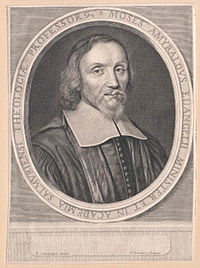
In the mid-1600's, French Reformed Pastor and Professor of Theology Moises Amyraut (sometimes latinized to Amyraldius) created a controversy in the Reformed Church of France by suggesting a reform of Calvinist theology. He opposed the teaching of a particular atonement (the "l" in TULIP, for "limited atonement"), while maintaining the doctrines of election and reprobation. His views came to be known as "Amyraldism" (or "Amyraldianism"), or as "four-point Calvinism." This view can often be found professed by individual Calvinists. However, as far as I have been able to determine, only the Grace Brethren Churches hold it as official denominational doctrine.
Amyraut

I have written several times on the biblical case for particular atonement, so I won't attempt to do so again here. Use the tag at the bottom to go to those posts. Rather, here I will deal specifically with Amyraut's attempt to remove the doctrine from the Calvinist system.

Amyraut's view boils down to this: 1) the Father has foreordained a certain number of individuals to salvation; 2) the Son died to atone for every sin of every member of the human race, without distinction; and 3) the Holy Spirit applies that atonement only to the elect. I think that the obvious reaction to this combination of precepts is that the Persons of the Trinity are put at cross purposes. However, the orthodox view of the Trinity forbids this. And Scripture concurs.

Jesus testified that He, the Second Person of the Trinity, does only the will of the Father, the First Person. See Luke 22:42 and John 5:19-24. And He further testified that the Holy Spirit, the Third Person, acts only in accord with the word of the Son (John 16:7-15). To have any contrary acts or intent within the Trinity is thus impossible. I consider this flaw to be fatal to any system of Calvinism which tries to incorporate the Arminian doctrine of universal redemption (except for the one who holds to universal salvation, which is a separate issue altogether.)

Saturday, September 14, 2013

An Answer to a Pentecostal Minister Regarding Predestination

I was recently watching a roundtable discussion on TV among several Pentecostal ministers. An emailer wrote in and asked the opinion of the panel regarding the doctrine of predestination. Among the responses was one by a panel member, in which he snorted, "'Whosoever will' is all you need to know." I believed that such a vacuous answer could not go unchallenged, so I emailed him the brief argument below. Due to his particular biases, I used the King James Version, rather than my usual ESV.  I will give his response at the bottom.

First, no one "wills" to come to God naturally, because we are all "dead in trespasses and sins" (Ephesians 2:1). As such, Paul says that "no one seeks God" (Romans 3:11). So you used that phrase to mean something that Scripture says is impossible. Rather, God must take the initiative to give us a new heart (Ezekiel 11:19-20 and 36:26-27).

In John 6:44, Jesus says, "No man can come to Me, except the Father which hath sent me draw him." And Paul makes the same point in Philippians 2:13, "it is God which worketh in you both to will and to do of His good pleasure." It is God that creates the will in us to respond to the Gospel. It isn't something that we have in us. Yes, it is "whosoever will," but only because God gives us that will to begin with. What He requires, He provides (John 1:13). Paul says that God even gives us the very repentance which is a part of our response to the Gospel: "In meekness instructing those that oppose themselves; if God peradventure will give them repentance to the acknowledging of the truth..." (II Timothy 2:25).

This is why I believe in predestination, because I have experienced the truth that it is only by God's ordination that I believed (Acts 13:48), and because my Jesus chose me, I did not choose Him (John 15:16). That is my assurance, that He is faithful and unfailing, regardless of how frail and faltering I am (John 6:39, 10:28-29).

Edited to remove identifying remarks, he responded, "Sir I am sorry to say but you follow false doctrine and obviously lack an understanding of God 's Holy Word. May I suggest you get the Expositors Study Bible from JSM.org then you will understand scripture. I will not debate this with you because I am very busy and if I need to be corrected on scriptures and doctrine then My pastors... will do that . Thanks"

Wednesday, September 11, 2013

The Problem of Evil: A Biblical Answer


A common argument against Biblical Christianity goes something like this: A good, omnipotent, and omniscient God is incompatible with the presence of evil in the world. Ironically, this argument from atheists is something that a Christian can actually agree with: evil is incompatible with the nature of God! However, the atheist then goes a step further and adds, there is evil in the world; therefore, there cannot be a good, omnipotent, and omniscient God, i.e., the God of Biblical Christianity.

The biblical answer to this dilemma must begin in Genesis, where God creates both the physical universe and mankind. These creations, by His own testimony, were "very good" (Genesis 1: 4, 10, 12, 18, 21, 25, and 31). There was no aging, sickness, death, or futility, in the lives of men. However, Adam chose to reject the goodness of the world and rebel against God (Genesis 3:1-19). Thus, Man chose to bring the debilitation of age, sickness, death, and futility, both for himself and for the physical world over which God had given him dominion. See the explanations of these curses in Romans 5:12 and 8:22.

So, the response of the Christian to this challenge of the atheists is straightforward: God did not create a world containing evil. Rather, mankind chose to reject the good world we had been given, for a world of hardship. And, out of justice, God allowed Man to have the world he preferred.

Now, we can turn this question back on the atheist: by what standard do you claim that some of the conditions in this world are evil? Afterall, the atheist rejects the overarching authority of God to define good and evil. This is what apologists call "precept stealing." The atheist actually requires the truth of Christian theism to provide his understanding of evil. His very question assumes the truth of what he seeks to undermine! By positing the very idea of "evil," the atheist demonstrates the truth of Paul's words in Romans 1:18-19, "[They] by their unrighteousness suppress the truth. For what can be known about God is plain to them, because God has shown it to them." That word "atheist" is a misnomer, in fact, a deception. The atheist knows the truth of the existence and righteousness of the triune God of the Bible. He then suppresses that knowledge, because he commits that sin of Adam all over again: he chooses to be his own god, but refuses to confess the consequences of that choice.

[This argument is borrowed, in part, from Scott Oliphint, the Professor of Apologetics at Westminster Theological Seminary, Philadelphia.]

Saturday, August 31, 2013

Ruth 2:1-16, the Overflowing Covenant

[Because of the length of this passage, I'm not going to quote the whole thing, but rather refer to particular verses in it.] 

Do you ever read portions of Scripture which just move your heart? Portions that give you a particular sense of gratitude to God and peace in His covenant? For me, Ruth, chapters 1 and 2, were such a portion. While I definitely believe that Ruth is historical, not allegorical, I also see in it strong and gratifying types of Jesus Christ, the ultimate biological expression of the events of the book.

In the first verse, we are introduced to Boaz, a kinsman of Ruth's late husband. In Hebrew, his name means "in him is strength," one of the clues that he is to be taken as a type for Jesus, his lineal descendant. The typology is reinforced by the placing of the events of the book, except the sojourn in Moab, in Bethlehem. The second verse describes Ruth supporting herself and her mother-in-law, Naomi, through gleaning, a biblical form of support for the indigent, established in Leviticus 19:9-10.  See also Deuteronomy 24:19. How beautiful it is to see this type of Christ providing his overflowing benefits to this alien from the covenant!

In verse 12, we have Boaz saying of Ruth, that she had "taken refuge under the wings" of Jehovah, an obvious indication of her true conversion. This was something that hadn't been clear earlier. In Ruth 1:16, Ruth had said that Naomi's God would be her God, but it wasn't clear that this was conversion, rather than mere loyalty to her mother-in-law. We see it confirmed, now, that Ruth had truly received the God of Israel by faith. This is a vibrant example of what is described in James 2:5, "Has not God chosen those who are poor in the world to be rich in faith and heirs of the kingdom?"

In verses 15 and 16, we see Boaz instructing his workers to give Ruth her gleanings, not from the post-harvest field alone, but even from that portion of the harvest which had been gathered for the storehouses. God does indeed bless His people with fruitfulness. He promises this in Deuteronomy 16:15, "The Lord your God will bless you in all your produce and in all the work of your hands." But His blessing isn't just a blessing of sufficiency, but rather a blessing which overflows even to the unbelievers around us! We see this described in Matthew 15:26-28, especially verse 26, "Even the dogs eat the crumbs that fall from their masters' table."

In chapter 1, I described Ruth's envy of Israel's covenantal relationship with Jehovah. Now, here in chapter 2, we see here experiencing second-hand those same covenantal blessings. Why? Because was now herself in covenant with the faithful, covenant-keeping God! This is a type of us! We who were once strangers of the covenant (Ephesians 2:12), have now received the benefits of the covenant, through the Jews (Romans 11:11-12)! This is because Boaz's descendant, Jesus Christ (Matthew 1:5), of whom Boaz was a type, received blessings from His Father to pass to us, His covenant people (John 15:15 and 17:18)! We have gleaned grace, sanctification, and glorification yet to come, typified here by Ruth, from the overflowing blessings of this same covenant-keeping God! To me, that is a source of great joy and comfort!

Thursday, August 29, 2013

Bishops in the Church (Part 1): the Bible versus Catholic Tradition

The Roman Catholic Church, the Eastern Orthodox churches, and the churches of the Anglican Communion, all practice the form of church government commonly called "episcopalian" or "prelacy." This is in contrast to the "presbyterian" and "congregationalist" systems. They claim that church history refers to government by bishops, and is found in the earliest church Fathers, including those of the immediate post-Apostolic period. And, as far as that goes, they are correct.

The reason that I say, "as far as that goes," is that it is a half-truth, leaving out a lot of relevant information, especially the simple fact that the word "bishop," a transliteration of the Greek word "episkopos," was used very differently from the way these churches use it.

There are two New Testament verses that refer to the "episkopoi" of particular congregations. Note that: "episkopoi" in the plural, not "episkopos" in the singular. In Philippians 1:1, Paul sends salutations to the Church at Philippi: "to all the saints in Christ Jesus, with the bishops and deacons" (KJV). The other is Acts 20:28 (cf  KJV margin). In both places, modern translations read "overseers," which is the literal translation of "episkopoi." The Acts passage, which begins at verse 17, is especially important, because it begins by referring to the "elders" of the Church at Ephesus, Greek "presbuteroi," and then changes to "episkopoi" for the same men.

The importance of these two verses is that they refer to multiple bishops in single congregations, utterly contrary to the single monarchical bishops of the episcopal churches.  In fact, in the immediate post-Apostolic period, the term came to refer, not to a regional monarchical official, but rather to the pastor of a city church. St. Jerome, that prominent church Father so often quoted by Catholic apologists, said, in his commentary on Titus, "A bishop is the same as a presbyter... [S]o let bishops know that they are greater than presbyters more by custom than in consequence of our Lord's appointment..." What he is referring to is Paul's instruction to Titus (in Titus 1:5) to appoint "elders," i.e., "presbuteroi," in every church. Note the plural, a plurality of elders, not a single monarchical figure. Then he continues in verse 7, "For an overseer (episkopos), as God's steward, must be above reproach." Paul uses both Greek terms to refer to the same men in the same office. That is why the New Jerusalem Bible, a Catholic translation, translates "episkopos" as "presiding elder," not "bishop."

Thus, in two ways, both the New Testament and the first church Fathers contradict the use that episcopalians put upon them. In contrast, they support the presbyterian church of government, which not only permits, but rather requires, multiple elders to govern each local church.

For Part 2, click here
 

Tuesday, July 30, 2013

Apostasy: A Critique of "Rome Sweet Home" by Scott Hahn


It is rare for me to be completely revolted when reading a book, especially a book on some aspect of theology, even theology that I disagree with. However, this book, the tale of the journey of a Presbyterian minister and his wife to conversion to Roman Catholicism, outraged me, with its appeals to sentiment, ignorance, and strawman arguments. Especially considering that it was written by a clergyman, someone that I would expect to write on a certain moral level. I definitely didn't find that level maintained in this book. In fact, two Bible verses come to mind to express my reaction. The first is Acts 20:30, "From among your own selves, will arise men speaking twisted things, to draw away the disciples after them." The other is I John 2:19, "They went out from us, but they were not of us; for if they had been of us, they would have continued with us." This book is a tale of bald-faced apostasy, with justifications that only the ignorant could swallow.

Let me begin with the most-deceptive elements. Scott Hahn begins by describing himself as a hardcore Calvinist in seminary. What he doesn't explain is why he chose to go to Gordon-Conwell Seminary, which is evangelical, but not Reformed. However, the answer becomes evident, even if unspoken. On page 31, Hahn informs us that he had come to "discover" that Saint Paul did not teach the doctrine of sola fide (justification by faith alone). Any Protestant reading that should be struck dumb, because we immediately think of such Pauline references as Romans 4:5, "To the one who does not work, but believes in Him who justifies the ungodly, his faith is counted as righteousness." Then Hahn adds his assertion that sola fide isn't taught anywhere in Scripture, claiming James 2:24 as his support. The reason I make such a point of this is to demonstrate that Hahn had abandoned Protestantism long before his official conversion.

We see the reason for this when Hahn mentions that he had become involved with Norman Shepherd, who was forced to leave Westminster Seminary for undermining the biblical view of justification. Hahn even mentions Shepherd's heresy trial, demonstrating that he was well-aware that those views were outside the pale of Reformed doctrine. Shepherd was the father of the Federal Vision movement, which has disrupted Reformed churches with an attempt to bring back this exact Catholic doctrine of justification. Hahn went to his first pulpit with these views, at a Federal Vision church, but does not say that he informed his presbytery of his views, a deceptive act. While there, he also began to teach at a tiny seminary, i.e., in spite of the "major seminary" claim of one article promoting him. Again, we see that this "Presbyterian" minister was never really Presbyterian.

In addition to his justification heresy, Hahn began the ministry with erroneous views on the sacraments. He complains, p. 49, about the Protestant doctrine of the Lord's Supper - or Eucharist, as he prefers to say - that it is a mere symbol. This is repeated on page 56. Unfortunately for him, that is not the Protestant view, at least among Lutherans, who hold to consubstantiation, or the Reformed, who hold to a spiritual, noncorporeal Real Presence. As the Westminster Confession of Faith XXIX:7 says, "Worthy receivers outwardly partaking of the visible elements in this sacrament, do then also, inwardly by faith, really and indeed, yet not carnally and corporally, but spiritually, receive and feed upon Christ crucified, and all benefits of His death; the body and blood of Christ being then, not corporally or carnally, in, with, or under the bread and wine; yet, as really, but spiritually, present to the faith of believers in that ordinance, as the elements themselves are to their outward senses." Which solution would be worse: that Hahn was ignorant of this doctrine? or that he was knowingly railing against a doctrinal strawman?

One of the endorsements on the back cover of the book says, "This book is inspiring and exciting for any reader desirous of rediscovering, from a scripture base, the reasons why the Catholic Church believes, teaches, and practices its doctrines." But this is exactly what the book doesn't do.We read statements such as, "I had fallen head over heels in love with the Lord in the Eucharist" (p. 88), and "I felt the Lord unleash his power through his mother" (p. 89). This is sentiment, not biblical exegesis. He also mentions direct revelations "from the Lord" on pages 114 and 115. Voices in the head are, again, not biblical exegesis.

This book, as well as other publications from Hahn, are promoted by (some, not all) the Catholic Church in an effort to convert Protestants. You can see them at his website, linked at the top, as well as here. This is what plays into the Acts 20:30 reference above; Hahn hasn't just committed apostasy himself, with his family, he wants to convince the rest of us evangelicals to follow him! God's warning to us is found in Deuteronomy 7:4, "[He] would turn away your sons from following Me, to serve other gods. Then the anger of the Lord would be kindled against you, and He would destroy you quickly." And God's warning to Hahn is found in Deuteronomy 13:5, "That prophet shall be put to death, because he has taught rebellion against the Lord your God."

A video by two ex-Catholic priests with a viewpoint opposed to Hahn's can be seen here