Monday, March 21, 2011

Ephesians 5:25 and Limited Atonement at Its Simplest

"Husbands, love your wives, as Christ loved the church and gave Himself up for her."

If one asks the question, "For whom did Christ die?", no more-straightforward answer than this one can be given. For her, i.e., the Church! Can it be more explicit? Here is limited or particular atonement in one sentence! One must really struggle to avoid that consequence of this verse. While it would be correct to say that it is not the thrust of Paul's intent to explain that doctrine here, it is necessary to recognize that it is his assumption of it that provides the basis of his instruction to the Christian husband.

Saturday, March 12, 2011

Strange Fire: The Abandonment of Sola Scriptura by American Evangelicals


I have written before about the abandonment of the opposition to Rome by modern Protestantism. Today, I want to write about the abandonment of Protestantism itself.

The Reformers established five principles which divided them from Rome, traditionally designated by their Latin forms: sola fide, sola gratia, sola Christus, sola scriptura, and soli gloria Deo. You can go here for my explanation of them.

Here in my hometown, a large church, called Lake Forest Church, promoted its Ash Wednesday service in the local newspaper (no longer available online). Lake Forest is a congregation of the Evangelical Presbyterian Chrurch, but check their website, and see how hard you have to look to find that connection. It never appears in their promotional announcements and advertising. According to the article, Lake Forest Pastor Mike Moses extolled the event on the basis that his congregation is "a modern church that delights in ancient practices."

And there lies my objection: instead of the Reformation principle of sola scriptura, scripture alone, Moses uses the Roman Catholic standard, i.e., tradition. As the Westminster Confession (XXI:1) says, "the acceptable way of worshiping the true God is instituted by Himself, and so limited by His own revealed will, that He may not be worshiped according to the imaginations and devices of men, or the suggestions of Satan, under any visible representation or any other way not prescribed in the holy Scripture." The Larger Catechism, answer 109, reads in part, "The sins forbidden in the second commandment are all devising, counseling, commanding, using, and anywise approving, any religious worship not instituted by God Himself." As a Presbyterian Church, the EPC, and Lake Forest Church as an affiliate thereof, are constitutionally committed to the WCF as its primary subordinate standard of doctrine (however, the EPC has extensively amended the WCF, and may actually have removed this passage; I simply don't know).

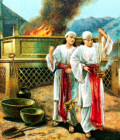
The WCF position, commonly referred to as "the regulative principle of worship," is based primarily on Deuteronomy 12:32, "Everything that I command you, you shall be careful to do. You shall not add to it or take from it." But it can be seen historically in the story of Aaron's sons, Nadab and Abihu, whom God executed for offering "strange fire," or "unauthorized fire" as worded by the ESV, on the altar of the tabernacle. See Leviticus 10:1, Leviticus 16:1, Numbers 3:4, and Numbers 26:61, for references to the story. Further explanation can be found in this article from Archibald Alexander Hodge, the son of Charles Hodge.

What separates Protestants from Catholics is that Protestants ask, "What do the Scriptures say?" while the Catholic apologetic appeals to the historicity of a practice. My question to Rev. Mike Moses is this: Human sacrifice is far more ancient than Ash Wednesday: according to your theology, does that make it equally- or even more valid? Sola scriptura gives one answer, but your apologetic seems to lead to another.

Sunday, February 27, 2011

According to the Koran, All Muslims Should Become Christians!

"We sent after them in their footsteps Jesus, son of Mary, verifying that which was before him of the Torah; and We gave him the Gospel containing guidance and light, and verifying that which was before it of the Torah, and a guidance and an admonition for the dutiful. And let the People of the Gospel judge by that which Allah has revealed in it. And whoever judges not by what Allah has revealed, those are the transgressors."
- The Koran, Sura 5, verses 46-47

We find something here in the Islamic Scriptures that I find very interesting. They teach that the Gospel, i.e., what Christians call the New Testament, was given to Jesus to provide guidance to His followers. And the final sentence clearly states that anyone who refuses to judge spiritual truth by the New Testament is a transgressor. There is no indication here of what has become a tradition among Muslims, that the Gospel has been corrupted.

They hold that Jesus was a great prophet. To my mind, that should indicate that what He said of Himself must therefore be taken as truth from God.

John 8:58, "Jesus said to them, 'Truly, truly, I say to you, before Abraham was, I am.'" Here, Jesus claims for Himself the divine name of God, I Am, found in Exodus 3:14, i.e., the very Torah of Moses that the Koran claims was confirmed by Jesus in the Gospel.

John 10:30, "I and the Father are one." Jesus identifies Himself with God the Father, not in Person, but in nature, using again the words of Moses, from Deuteronomy 6:4.

John 14:7, "If you had known Me, you would have known My Father also. From now on you do know Him and have seen Him.” And 14:9, "Whoever has seen Me has seen the Father." Jesus claims that to know Him is to know the Father.

John 16:15, "All that the Father has is Mine." Here is a clear claim to divine omnipresence and omniscience, for they are logically necessary to identify all that is the Father's.

John 17:11, "Holy Father, keep them in Your name, which You have given me, that they may be one, even as We are one." In this portion of what is called His High Priestly Prayer, Jesus again claims a clear identification of Himself with His Heavenly Father.

John 20:28-29, "Thomas answered Him, 'My Lord and my God!' Jesus said to him, 'Have you believed because you have seen Me? Blessed are those who have not seen and yet have believed.'" Here, in a post-resurrection meeting, the Apostle Thomas proclaims His recognition of Jesus as Lord and God! If it weren't so, shouldn't Prophet Jesus have protested against Thomas's declaration as idolatry? That is exactly the accusation that Muslims make against Christians. Apparently, Jesus is guilty of the same sin! But then the Muslim is trapped by his own logic, because a man cannot be a great prophet if he allows idolatry!

My point here is that the very beliefs of Islam, if followed consistently, must force the Muslim to become a Christian. And I will offer the Muslim one even more-compelling reason, again in Jesus's own words, John 14:6, "
Jesus said to him, 'I am the way, and the truth, and the life. No one comes to the Father except through Me.'" Jesus declares that there is no way for access to God in heaven without His mediation. But He also gives this promise, John 6:37, "All that the Father gives Me will come to Me, and whoever comes to Me I will never cast out." We have His promise to receive all who come to Him, that we may know without doubt that we have received eternal life. Is that an assurance that Islam can give you?

Sunday, February 20, 2011

"Signs and Wonders" for When? And by Whom?

I have posted before about my opinion of the "miracles" associated especially with the charismatic-pentecostal movement. My position is commonly referred to as "cessationism," i.e., the belief that the miraculous gifts of the Spirit were intended for the apostolic period only, and ceased with the passing of the Apostles. That is not to say that miracles cannot or do not still occur, but rather that they are no longer the norm.

My fellow reformed blogger Andy, himself a converted Pentecostal, has written on this issue much more competently than I can (see here and here), so I refer you to him for a detailed biblical case for cessationism. I wish here only to give some brief thoughts that arose during the sermon in church today.

The sermon was on Acts 2:42-47, and focused on the Lord's vision of the how the church should work. But, as it is wont to do, my mind was sidetracked at verse 43, the latter portion, "many wonders and signs were being done through the apostles." Who did the signs and wonders? Not the whole church, but specifically the Apostles! I was also reminded of Hebrews 2:3-4, "How shall we escape if we neglect such a great salvation? It was declared at first by the Lord, and it was attested to us by those who heard, while God also bore witness by signs and wonders and various miracles and by gifts of the Holy Spirit distributed according to his will." Again, the miraculous gifts were given to verify the testimony of the Apostles!

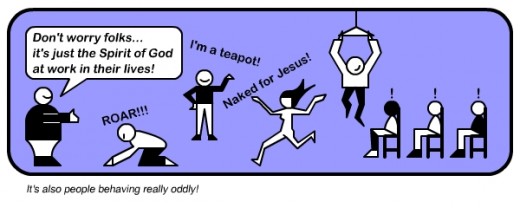
I think that this explains why so much of Pentecostalism (by no means am I saying all) degenerates into a circus atmosphere and bizarre doctrine. They are focusing on the signs, instead of teaching what the signs gave testimony to!

Wednesday, February 9, 2011

The Judgeship of Deborah and Male Headship


"As for My people, children are their oppressors, and women rule over them."        - Isaiah 3:12 ASV

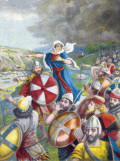
In Judges, chapter 4, we have the story of Deborah, the only female judge of Israel. In verse 4, she is described as a prophetess and judge, so she is both the political and religious leader of Israel (though I assume there was still a high priest). Believing as I do that both of these offices are parts of God's calling for men, not women (I Timothy 2:12), I was pondering this evening what the significance is of her holding these offices.

Note further in Judges 4:7, where she has delivered God's commandment to Barak, the chief general of Israel, to go out to battle against the oppressors of Israel. His response in the next verse is telling: "If you will go with me, I will go, but if you will not go with me, I will not go." It is as if he said that he needs her to hold his hand, so he won't be afraid of the bogeyman. Deborah bluntly tells him in verse 9 that the glory for the victory will go to a woman. Even Sisera, the enemy general, turns out to be a wimp. Verse 20 reads, "And he said to her, 'Stand at the opening of the tent, and if any man comes and asks you, 'Is anyone here?' say, 'No.'" He sends a woman out to guard him as he sleeps!

I think that we have here a disparaging view of the spiritual condition of Israel. Her men had been so feminized and spiritually-castrated that there was no man for God to call into leadership (humanly-speaking; I certainly would never say that God cannot graciously raise a man above his natural ability). Do we not see that condition developing in our own country? I see more and more female preachers on TV. My home state has a female governor. Our federal secretary of state is a woman. The previous speaker of the US House was a woman. Will we soon see our own Deborah?

Sunday, January 30, 2011

The Pre-Incarnate Mediatorial Role of Christ in the Old Testament

The Lord was very angry with your fathers. Therefore say to them, Thus declares the Lord of hosts: Return to Me, says the Lord of hosts, and I will return to you, says the Lord of hosts. Do not be like your fathers, to whom the former prophets cried out, ‘Thus says the Lord of hosts, Return from your evil ways and from your evil deeds.’ But they did not hear or pay attention to Me, declares the Lord. Your fathers, where are they? And the prophets, do they live forever? But My words and My statutes, which I commanded My servants the prophets, did they not overtake your fathers? So they repented and said, As the Lord of hosts purposed to deal with us for our ways and deeds, so has He dealt with us.” The word of the Lord came to the prophet Zechariah, the son of Berechiah, son of Iddo, saying, “I saw in the night, and behold, a man riding on a red horse! He was standing among the myrtle trees in the glen, and behind him were red, sorrel, and white horses. Then I said, ‘What are these, my lord?’ The angel who talked with me said to me, ‘I will show you what they are.’ So the man who was standing among the myrtle trees answered, ‘These are they whom the Lord has sent to patrol the earth.’ And they answered the angel of the Lord who was standing among the myrtle trees, and said, ‘We have patrolled the earth, and behold, all the earth remains at rest.’ Then the angel of the Lord said, ‘O Lord of hosts, how long will You have no mercy on Jerusalem and the cities of Judah, against which You have been angry these seventy years?’ And the Lord answered gracious and comforting words to the angel who talked with me. So the angel who talked with me said to me, ‘Cry out, Thus says the Lord of hosts: I am exceedingly jealous for Jerusalem and for Zion. And I am exceedingly angry with the nations that are at ease; for while I was angry but a little, they furthered the disaster. Therefore, thus says the Lord, I have returned to Jerusalem with mercy; My house shall be built in it, declares the Lord of hosts, and the measuring line shall be stretched out over Jerusalem. Cry out again, Thus says the Lord of hosts: My cities shall again overflow with prosperity, and the Lord will again comfort Zion and again choose Jerusalem.’
- Zechariah 1:2-17

One of the errors which has been perpetrated down through history is that the mediatorial office of Christ began at His ascension. After all, wasn't His mediatorial work based on His crucifixion and resurrection? And, of course, it was. However, I believe that the Scriptures teach that the Second Person of the Trinity was active in mediating between God, i.e., the First Person, and His people throughout history, including the Old Testament dispensation, looking forward to His mediatorial sacrifice. This is the basis of His priestly office.

We see that work here in Zechariah 1. The section begins with a record of God's judgments on Israel for her idolatry, See especially verse 6. Then the Angel of the Lord appears in verse 8 (revealed as such in verse 11).

I agree with the traditional understanding that the Angel of the Lord (specifically, not angels in general) is the pre-incarnate Second Person of the Trinity, due to the interchange of His identity with that of the Lord in various parts of the historical portions of the Old Testament. See, for example, Genesis 16:7-11, compared with verse 13. The Angel of the Lord is described distinctly, yet identified with Jehovah, a classical representation of these two Persons of the Trinity.

Now, back in Zechariah 1, we see the Angel speaking up for the remnants of Judah. In verse 12, He asks, "O Lord of hosts, how long will You have no mercy on Jerusalem and the cities of Judah, against which You have been angry these seventy years?" And immediately we see a change in the countenance of Jehovah. Where we saw His wrath, as described above, now contrariwise in verse 13 we read, "and the Lord answered gracious and comforting words to the angel who talked with me." From wrath to grace and comfort, merely in response to the Mediator's interposition.

For us, we should find much comfort here. We see the covenantal faithfulness of Christ, revealed even centuries before He was born in the manger. And we see the righteous wrath of God, which we have every reason to fear, turned aside by our theanthropic Mediator. What peace that should be to each of His people! And for those who hold erroneous views of the person of Christ, such as Jehovah's Witnesses, the Word witnesses against you, and you cannot hope in the mediatorial work of that Christ Whom you malign!

Sunday, January 23, 2011

The Rock: Papal Claims of Supremacy Examined by Scripture


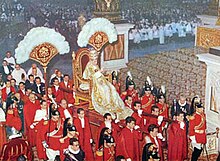
The Church of Rome claims that the Pope is the supreme head of the organized church on earth, meaning that anyone refusing that supremacy is by definition outside Christ. The Eastern Orthodox Churches, Oriental Independent Churches (such as the Coptic Church in Egypt), and Protestants have always refused and denied that supremacy.

Since the Bible alone, not the opinion of men, is the final standard in spiritual matters, that testimony alone must be the deciding issue.

The trail of logic in Roman theology holds that the Apostle Peter was given supremacy over the other apostles by Christ Himself in Matthew 16:17-19. After Christ's ascension, Peter moved to Rome and became bishop of the church there, where he revealed that his authority was to be passed by succession to all future bishops of Rome after him. So, the questions involved are, Did Peter receive supremacy over the other Apostles? Did he become a bishop, and, if so, was his diocese in Rome? And finally, did his supremacy succeed through the office of bishop in Rome, to all future popes?

On Peter's supposed supremacy, the essential portion is in verse 18, "I tell you, you are Peter, and on this rock I will build my church..." Jesus is making a play on words, for the name Peter, both in Greek and Aramaic, is the masculine form of the word for "rock." However, is Peter the rock He means? Jesus refers to Himself, and is referred to by the apostles , including Peter himself, as the chief cornerstone (Matthew 21:42, Ephesians 2:20, and I Peter 2:6-7). So, referring back to Himself as the rock would be consistent with Scriptural usage. Some interpret the rock as being Peter's confession of Christ. Either one meets the demands of parsimony far better than does the interpretation of Rome. In Ephesians 2:20, Paul even refers to the church's being built on the apostles as a group! Were the apostles, including Peter, simply confused? I guess the Church of Rome must know better than the apostles themselves did!

Further, what was the attitude of the other apostles to Peter? I believe that the testimony of Paul is especially telling. In Galatians 2, Paul is addressing the failure of Peter to oppose the intrusion of the Judaizers into that church. In verse 11, Paul tells us, "
when Cephas ["Peter" in Aramaic] came to Antioch, I opposed him to his face, because he stood condemned." Paul didn't submit to some supposed supremacy of Peter. Rather, he opposed him to his face, and explicitly states that Peter was in error! Earlier in this same passage, Paul also mentions another point that throws a major monkey-wrench into Papal claims. One time each in verses 8 and 9, Paul refers to himself as the apostle to the Gentiles, while the other apostles worked among the circumcision, i.e., the Jews. Logically speaking, that is not consistent with a supposed bishopric of Peter in Rome. While a strong tradition supports the belief that he was martyred there, it would not have been an obvious place for Jewish evangelism and discipleship.

The claim that Peter then left his authority to his Papal successors is made of whole cloth, supposedly on the tradition of apostolic succession. That is, Rome claims that the evidence for their succession to Peter is authoritative because the popes have always held it to be. Such circular reasoning and self-aggrandizement is self-evident.

Of course, I would add a more-fundamental objection: as I have said before, the Bible knows nothing of the monarchical bishop, as practiced in the Church of Rome, the Eastern Churches, and the branches of the Church of England. If the office of bishop is a fiction, then any supposed authority passed through it is a moot point! I believe that the Bible vigorously and unequivocally maintains the Protestant view of Papal Supremacy, which is stated in the Westminster Confession of Faith XXV:6, "There is no other head of the Church but the Lord Jesus Christ: nor can the Pope of Rome in any sense be head thereof; but is that Antichrist, that man of sin and son of perdition, that exalteth himself in the Church against Christ, and all that is called God."