Wednesday, September 16, 2009

The Doctrine of Reprobation: Laying the Ax to the Pride of Men

"For certain people have crept in unnoticed, who long ago were designated for this condemnation, ungodly people, who pervert the grace of our God into sensuality and deny our Master and Lord, Jesus Christ."
-Jude 1:4

Of the distinctive doctrines associated with the nickname "Calvinism", two are particularly anathematized by devotees of free-willism: reprobation, the doctrine that God has actively preordained some for unbelief, hardening, and judgment; and particular atonement, the doctrine that Christ died for a certain number, eternally decreed by God, rather than for men universally. I want here to address the first.

Jude here describes certain people who have been designated for condemnation. Those individuals are contrasted with others in verse 3 who hold to the faith of the saints. Paul addresses the same preordination in Romans 9:11-13, "Though they were not yet born and had done nothing either good or bad - in order that God's purpose of election might continue, not because of works but because of His call - she was told, 'The older will serve the younger.' As it written, 'Jacob I loved, but Esau I hated.'" God declared in advance that He chose Jacob by name, but rejected Esau by name, out of His sovereign decree of election, explicitly not because of the qualities of the brothers.

Even among some Reformed folks, the doctrine of reprobation is misrepresented as a passive act of God, in which He merely refrains from electing a person to salvation, the view of Lutherans. They are still too attached to human worthiness to accept that God actively devotes some to eternal destruction. But the Scriptures do not bend to their squeamishness. Paul continues in Romans 9:20-24, "But who are you, O man, to answer back to God? Will what is molded say to its molder, 'Why have You made me like this?' Has the potter no right over the clay, to make out of the same lump one vessel for honored use and another for dishonorable use? What if God, desiring to show His wrath and to make known His power, has endured with much patience vessels of wrath prepared for destruction, in order to make known the riches of His glory for vessels of mercy, which He has prepared beforehand for glory?" Notice that Paul doesn't explain God's decree of reprobation. Rather, he condemns our presumption in questioning it. After all, as creatures, we rebel when we demand explanations from our Creator. Do we not claim the same right when we tell our children, "because I said so"?

The Westminster Confession of Faith (III:7) summarizes these biblical statements this way: "The rest of mankind God was pleased, according to the unsearchable counsel of His own will, whereby He extendeth or withholdeth mercy, as He pleaseth, for the glory of His sovereign power over His creatures, to pass by; and to ordain them to dishonor and wrath, for their sin, to the praise of His glorious justice." Notice that the confession does not describe reprobation as a passive allowing, but rather as an active ordaining.

Our fallen hearts naturally rise up and demand that God explain His actions. After all, who does He think He is? "I think I am God, and that you aren't," is His answer. And that should bring Paul's question to mind again: Who are you, O man, to answer back to God?

Tuesday, September 15, 2009

The Psalms, The Prosperity of Zion, and the Glory of God

"You, O Lord, are enthroned forever; You are remembered throughout all generations. You will arise and have pity on Zion; it is time to favor her; the appointed time has come. For Your servants hold her stones dear and have pity on her dust. Nations will fear the name of the Lord, and all the kings of the earth will fear Your glory. For the Lord builds up Zion; He appears in His glory; He regards the prayer of the destitute and does not despise their prayer.

"Let this be recorded for a generation to come, so that a people yet to be created may praise the Lord: that He looked down from His holy height; from heaven the Lord looked at the earth, to hear the groans of the prisoners, to set free those who were doomed to die, that they may declare in Zion the name of the Lord, and in Jerusalem His praise, when peoples gather together, and kingdoms, to worship the Lord."
- Psalm 102:12-22

To interpret these verses as applying exclusively, or even primarily, to the physical Jerusalem in Israel is to turn this passage against itself. While it refers to nations fearing the name of the Lord, a future people praising the Lord, and the liberated declaring His name and praise, and gathering to worship Him - all of which are spiritual activities - it would then be a nonsensical shift to be talking of a geographical location. Surely this is that spiritual Zion mentioned explicitly in Hebrews 12:22, "But you have come to Mount Zion and to the city of the living God, the heavenly Jerusalem, and to innumerable angels in festal gathering..." This is the Zion, the heavenly Jerusalem, that is a reference to the Church, by the name of her Old Testament type.

This same gathering of the nations to the Church is mentioned by the Prophet Isaiah. For example, see Is. 60:3, "And nations shall come to Your light, and kings to the brightness of Your rising." He uses almost identical wording, reinforcing the application of these prophecies to the Gospel Church.

The Westminster Larger Catechism, question 191, interprets the second petition of the Lord's Prayer ("thy kingdom come"), in part, as praying for "the Gospel [to be] propagated throughout the world, the Jews called, [and] the fullness of the Gentiles brought in." The Westminster Directory for Public Worship enjoins that prayer be raised "for the propagation of the Gospel and kingdom of Christ to all nations, for the conversion of the Jews, [and] the fulnesse of the Gentiles."

The belief in the prosperity of Zion through the power of God in the Gospel is taught in Scripture and has been the historical desire and love of God's people. The negativism and malaise that now dominate the Church have come in through the infection of dispensationalism, in all its factions. May God restore the Church to the power that her oldtime faith gave her!

Thursday, September 10, 2009

God's Controversy with False Teachers: The Feel-Good Gospel of American Evangelicalism

"'In the prophets of Jerusalem I have seen a horrible thing: they commit adultery and walk in lies; they strengthen the hands of evildoers, so that no one turns from his evil; all of them have become like Sodom to Me, and its inhabitants like Gomorrah.' Therefore, thus says the Lord of hosts concerning the prophets: 'Behold, I will feed them with bitter food and give them poisoned water to drink, for from the prophets of Jerusalem ungodliness has gone out into all the land.'

"Thus says the Lord of hosts: 'Do not listen to the words of the prophets who prophesy to you, filling you with vain hopes. They speak visions of their own minds, not from the mouth of the Lord. They say continually to those who despise the word of the Lord, "It shall be well with you"; and to everyone who stubbornly follows his own heart they say, "No disaster shall come upon you."'"
- Jeremiah 23:14-17

Telling anyone of his sin has become passe in today's spiritual world. Whether we are talking about liberal theologians who simply dismiss the very concept of sin, or about feel-good evangelicals like Joel Osteen, it just isn't good form to tell a man that he is a sinner under the judgment of God.

The prophet Isaiah also spoke about these ecclesiastical quislings (Is 5:20): "Woe to those who call evil good and good evil, who put darkness for light and light for darkness, who put bitter for sweet and sweet for bitter."

Jeremiah warns these teachers (verses 26-29): "How long shall there be lies in the heart of the prophets who prophesy lies, and who prophesy the deceit of their own heart, who think to make My people forget my name by their dreams that they tell one another, even as their fathers forgot My name for Baal? Let the prophet who has a dream tell the dream, but let him who has My word speak My word faithfully. What has straw in common with wheat? declares the Lord. Is not My word like fire, declares the Lord, and like a hammer that breaks the rock in pieces?"

The true word of God breaks the sinner's heart like a rock, because his heart must be broken before he will turn to Jesus for salvation. A false teacher will massage the sinner's self-esteem all the way to Hell. Which one is actually helping the sinner? Your eternity may depend on how you answer that question.

Tuesday, September 8, 2009

The Universalism of the Covenant of Works versus the Particularity of the Covenant of Grace

This is another passage from Peter Bulkeley's "The Gospel Covenant." I find great spiritual sweetness in it. Odd spellings and grammar are in the original, as are the italics.

"The covenant of works was made with all men, all men being in Adams loins, and he standing as a publique person in the roome of all his children, when God made that covenant with him: but the covenant of grace is not made with all men, but onely with the faithfull, with those that are given unto Christ by the Father, John 17. And therefore by the covenant of works, God is a God to one as well as to another; God is not a God of one people more than another, by the covenant of workes, for it was made equally with us all in Adam, it being made with him for all his posterity. And therefore seeing wee are all equally the sons of Adam, this Covenant makes no difference betwixt man and man, but all are shut up under it, all bound to fulfill it; and if they breake it (as wee all doe), then liable are we to the sentence of death. But in the Covenant of grace, God is the God of one people, and not of another. Hence is that in Gen. 17:21. God saith that he will establish his Covenant with Isaac, and not with Ishmael: So it was made with Jacob and not with Esau, with Abel and not with Cain, with David and not with Saul; not with Judas, but with Peter; with the Jewes first, and not with the Gentiles; and after, with the Gentiles, and not with the Jewes. By this Covenant one people becomes a more peculiar people then another. As first of Peter, 2 chap. The Covenant of grace is not universal, it is not made with all, as the Covenant of workes was."

Monday, September 7, 2009

Sunday Christians, Weekday Pagans

"Behold, you trust in deceptive words to no avail. Will you steal, murder, commit adultery, swear falsely, make offerings to Baal, and go after other gods that you have not known, and then come and stand before Me in this house, which is called by My name, and say, 'We are delivered!' - only to go on doing all these abominations? Has this house become a den of robbers in your eyes? Behold, I Myself have seen it, declares the Lord."
- Jeremiah 7:6-11

Most of us will immediately associate these verses with the tradition of auricular confession, the belief that the priest can forgive all one's sins after confession. But it isn't just that superstition that is addressed here. Too many professing Christians of all stripes act like they get get a new supply of spiritual get-out-of-jail-free cards whenever they go to church on Sunday, so that they can cover their unchristian actions during the week. "Want to cheat your customer? Go ahead, you still have credit at the Jesus Bank and Trust". And we have all seen the reckless driver with the "God is my co-pilot" and "child on board" bumper stickers. And what about the person who acts haughty to a waiter or salesperson, but then adopts angelic humility when he or she walks in the church door?

The great commentator Matthew Henry says, in part, regarding this passage: "The privileges of a form of godliness are often the pride and confidence of those that are strangers and enemies to the power of it. It is common for those that are furthest from God to boast themselves most of their being near to the church. They are haughty because of the holy mountain (Zep. 3:11), as if God's mercy were so tied to them that they might defy his justice."

The passage to which he refers (Zephaniah 3:11-13) gives us the alternative: "On that day you shall be put to shame because of the deeds by which you have rebelled against Me; for then I will remove from your midst your proudly exultant ones, and you shall no longer be haughty in My holy mountain. But I will leave in your midst a people humble and holy. They shall seek refuge in the name of the Lord, those who are left in Israel; they shall do no injustice and speak no lies, nor shall there be found in their mouth a deceitful tongue. For they shall graze and lie down, and none shall make them afraid."

God is not fooled by your Sunday religion. Are you?

Friday, September 4, 2009

The Sodomites of Jerusalem


"Run to and fro through the streets of Jerusalem, look and take note! Search her squares to see if you can find a man, one who does justice and seeks truth, that I may pardon her. Though they say, 'As the Lord lives,' yet they swear falsely. O Lord, do not Your eyes look for truth? You have struck them down, but they have felt no anguish; You have consumed them, but they refused to take correction. They have made their faces harder than rock; they have refused to repent."
- Jeremiah 5:1-3

It's pretty easy to see that this prophecy would have won Jeremiah no friends in the seat of Judah. His hearers could not have failed to hear the remembrance of the story of Sodom and Gomorrah. In Genesis 18, after God has told Abraham of His plans to destroy Sodom and Gomorrah for their wickedness, Abraham is moved to intercede for them. Verses 23-26: "Then Abraham drew near and said, 'Will You indeed sweep away the righteous with the wicked? Suppose there are fifty righteous within the city. Will You then sweep away the place and not spare it for the fifty righteous who are in it? Far be it from You to do such a thing, to put the righteous to death with the wicked, so that the righteous fare as the wicked! Far be that from You! Shall not the Judge of all the earth do what is just?' And the Lord said, 'If I find at Sodom fifty righteous in the city, I will spare the whole place for their sake." The discussion winds down finally to ten righteous, for lack of whom Sodom is doomed. Apparently, Jerusalem also fails to count ten righteous, because it was indeed destroyed by the Babylonians in 586 BC.

In fact, in the New Testament, the hardness of Jewish hearts is decried as worse than those of Sodom. Jesus, speaking in Matthew 11:23-24, warns his hearers, "And ... will you be exalted to heaven? You will be brought down to Hades. For if the mighty works done in you had been done in Sodom, it would have remained until this day. But I tell you that it will be more tolerable on the day of judgment for the land of Sodom than for you."

The word "sodomite" is thrown around as if its targets were the worst sinners imaginable, yet Scripture warns of a hardness of heart that God hates more than any sin attributed to the people of Sodom. I hate that easy judgmentalism! But I know that it is easier to point the finger than it is to examine one's own spiritual condition. May we heed the warning of Jesus Himself.

Wednesday, September 2, 2009

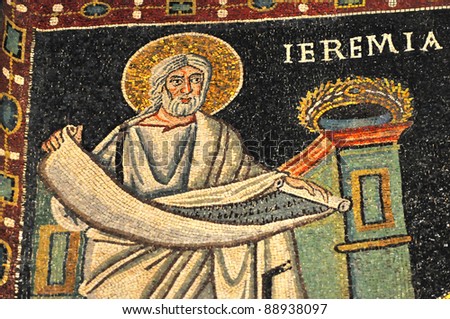
Jeremiah 1:4-12, The God-Called Preacher

"Now the word of the Lord came to me, saying, 'Before I formed you in the womb I knew you, and before you were born I consecrated you; I appointed you a prophet to the nations.' Then, I said, 'Ah, Lord God! Behold, I do not know how to speak, for I am only a youth.' But the Lord said to me, 'Do not say, "I am only a youth"; for to all to whom I send you, you shall go, and whatever I command you, you shall speak. Do not be afraid of them, for I am with you to deliver you, declares the Lord.' Then the Lord put out His hand and touched my mouth. And the Lord said to me, 'Behold, I have put My words in your mouth. See, I have set you this day over nations and over kingdoms, to pluck up and to break down, to destroy and to overthrow, to build and to plant.' And the word of the Lord came to me, saying, 'Jeremiah, what do you see?' And I said, 'I see an almond branch.' Then the Lord said, 'You have seen well, for I am watching over my word to perform it.'" [In Hebrew, "almond" and "watching" are closely similar.]

Notice the pattern here: the calling of God to Jeremiah was prior, not just to his intent, but even to his awareness, even from the womb. The man of God doesn't claim a place in His ministry; he is called to it, even against his expectations and desires: "I am only a youth."

There is a parallel here to the calling of Isaiah, 6:5-9: "And I said: 'Woe is me! For I am lost; for I am a man of unclean lips, and I dwell in the midst of a people of unclean lips; for my eyes have seen the King, the Lord of hosts!' Then one of the seraphim flew to me, having in his hand a burning coal that he had taken from the altar. And he touched my mouth and said: 'Behold, this has touched your lips; your guilt is taken away, and your sin atoned for. And I heard the voice of the Lord saying, 'Whom shall I send, and who will go for Us?' Then I said, 'Here am I! Send me.' And He said, 'Go, and say to this people...'", etc.

When he became conscious of God's calling of him, Jeremiah protested because of his youth. Likewise, Isaiah protested his sinfulness. The godly man claims no qualifications, for he can have none to offer. Jeremiah was youthful, and Isaiah was a sinner. Their very disqualifications made room for the grace of God and the working of His Holy Spirit, untarnished by the mediatorship of men.

In contrast, across the page, Jeremiah shows us that prophet whom God has not called, but is rather the mouthpiece of Hell. In 2:7-8, we read, "And I brought you out into a plentiful land to enjoy its fruits and its good things. But when you came in, you defiled My land and made My heritage an abomination. The priests did not say, 'Where is the Lord?' Those who handle the law did not know Me; the shepherds transgressed against Me; the prophets prophesied by Baal and went after things that do not profit." The false preacher turns the people away from their faithfulness, turning from His Law to strange and new doctrines. He continues, in verses 26-27, "As a thief is shamed when caught, so the house of Israel shall be shamed: they, their kings, their officials, their priests, and their prophets, who say to a tree, 'You are my father', and to a stone, 'You gave me birth.'For they have turned their back to Me, and not their face. But in the time of trouble they say, 'Arise and save us.'"

The false preacher is happy to stoke the religiosity of his flock during time of trouble, but the God-called preacher speaks the words of God at all times, whether to break down the resistant or to build up the repentant, for God watches over His word, to perform it (1:12; see also Isaiah 55:11). The God-called preacher speaks the truth to nations and to kingdoms, while the false minister is concerned to tickle the ears of his audience (II Timothy 4:3).