Saturday, April 13, 2019

Is the Church Teaching the Lie of Satan?

We often talk about Europe as a "post-Christian culture." Then the conversation often moves to America, which is already "post-modern," and moving in the same direction as Europe. The so-called "nones," those who say they have no religion, are increasing as a proportion of the American population. The church has less and less influence in social issues.

Why is that?

In Europe, we see portions that have never known the biblical Gospel, because they were controlled by the Catholic Church. As that organization, not truly a church, lost political power, people were freed from its power, but had no spiritual reality to take its place. In the areas that had known the Gospel because of the Reformation, its influence had been undermined by the influence of higher criticism, and the failure of the

churches to exercise discipline in the face of  bald unbelief. As state churches, they were expected to include the entire population in their membership, and depended on state subsidies for their finances. They simply surrendered to the spirit of unbelief.

Here in America, evangelicalism has always been stronger than in Europe. The separation from the state and a voluntary membership has enabled the churches to exercise discipline - when they chose. While some church organizations have given in to the same higher criticism that conquered Europe, others have maintained their faithfulness to the Gospel and our God and Savior Jesus Christ.

However, now that evangelical remnant is decaying from the inside out. Prominent place has been given to mysticism, mainly through the Pentecostal movement, so that faith has become subjective rather than a faith in objective historical truths and events. A pietistic mentality has taken over, in which one's private spiritual experience takes precedence over the objective facts of the historic Christian faith. And a growing Prosperity movement has come to equate faith with personal success.

In other words, we witness with our eyes the professing evangelical movement's giving itself over to the very promise with which Satan brought down Adam and Eve: "God knows that when you eat of it [i. e., the Tree of the Knowledge of Good and Evil] your eyes will be opened, and you will be like God, knowing good and evil" (Genesis 3:5). The deception of Satan was his promise to Adam and Even that betraying the God who made them would make them autonomous, with the authority to decide good and evil for themselves, rather than receiving their definitions from God.

And this is what has deprived the American evangelical movement of influence and effect. If personal prosperity and sovereignty are valid, then the truth of God is just an optional alternative. There can be no grounds for calling to account either individuals or officials who stand for wickedness. Wickedness and righteousness become equally valid. The salt has lost its savor: "You are the salt of the earth, but if salt has lost its taste, how shall its saltiness be restored? It is no longer good for anything except to be thrown out and trampled under people’s feet" (Matthew 5:13).

My message of warning is less to the apostates in American society than it is to the remnants of the church: "I know your works: you are neither cold nor hot. Would that you were either cold or hot! So, because you are lukewarm, and neither hot nor cold, I will spit you out of My mouth. For you say, I am rich, I have prospered, and I need nothing, not realizing that you are wretched, pitiable, poor, blind, and naked. I counsel you to buy from Me gold refined by fire, so that you may be rich, and white garments so that you may clothe yourself and the shame of your nakedness may not be seen, and salve to anoint your eyes, so that you may see. Those whom I love, I reprove and discipline, so be zealous and repent" (Revelation 3:15-19).

Wednesday, April 10, 2019

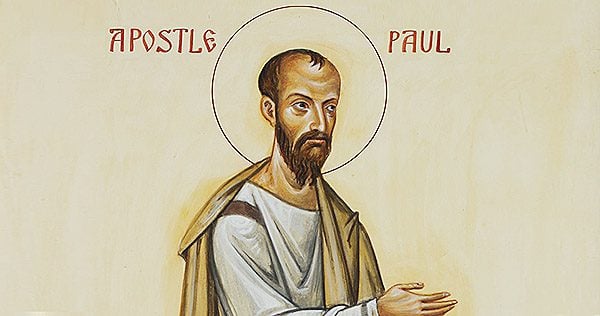
The Apostle Paul versus Catholic Saints

"For to me to live is Christ, and to die is gain. If I am to live in the flesh, that means fruitful labor for me. Yet which I shall choose I cannot tell. I am hard pressed between the two. My desire is to depart and be with Christ, for that is far better. But to remain in the flesh is more necessary on your account. Convinced of this, I know that I will remain and continue with you all, for your progress and joy in the faith" (Philippians 1:21-25).

The verses above are an expression of the ambivalence that Paul felt about the approach of death. The epistle was probably written a few years before his martyrdom in 68AD. Did he know that it was approaching? We don't know. If he did, he doesn't explicitly say so, either here or in any of the other extant Pauline letters. But, at least hypothetically, he was considering a coming time when he would be spiritually absent. That knowledge produced a conflict within him. He gloried in the thought of being with Jesus in Heaven. However, he was also aware of the frailty of the churches that would be left behind, such as this one in Philippi.

The thing I want to focus on is something that Paul does not say. Even though he is concerned about the aid that will be needed by these Philippian Christians, he does not say, "Oh, well, the problem is solved, because you will be able to pray to me in heaven, and I will be able to intercede with Jesus for you, just as I do in this earthly life." Yet, that is what the Roman Catholic and Eastern Orthodox churches teach about the dead saints in Heaven, especially Mary.

If their doctrine of saints were true, then Paul's dilemma would not exist. Therefore, we can know that Paul did not believe anything comparable to the Catholic/Orthodox doctrine of saints. It is just simple but necessary logic.

Saturday, April 6, 2019

Dispensationalism Bows to the Kingship of Satan

I recently came across this interview with Jerry Falwell, Jr., the son of the late-founder of the Moral Majority, that bogeyman of liberals back in the Reagan era. In it, Falwell is quoted as saying, "It’s such a distortion of the teachings of Jesus to say that what he taught us to do personally — to love our neighbors as ourselves, help the poor — can somehow be imputed on a nation. Jesus never told Caesar how to run Rome." I am appalled by the statement, and I think that the elder Falwell would have been appalled, too.

First, let me say that Junior's statement is consistent with his dispensationalist hermeneutic. Senior's political activism was inconsistent with that same hermeneutic. I am not suggesting any hypocrisy on the part of Falwell. However, I must question the rationality of the statement. Mr, Falwell, how can you say that Jesus advocated a morality only for individuals, that He did not also intend for us to live collectively? That would be like saying that the Sixth Commandment forbids me to murder, but places no obligation on society to strive to prevent or punish murder!

In addition, has Falwell not read the Old Testament? I often wonder that when addressing dispensationalists. If he has, then he is deliberately ignoring the statements in the Law and the history books that God judges a society for its injustices. He doesn't merely judge individuals. When the Assyrians destroyed the Northern Kingdom, or when the Babylonians destroyed the Southern Kingdom, are we to imagine that there were no godly residents in either country who suffered together with their societies? That would not be a rational expectation.

I refer to this tendency among dispensationalists as "surrenderism," a presupposition that the Bible, Christianity, and the Church are doomed to fail, so we are to make no more than token efforts to apply God's word to all of life. That attitude is the opposite of the first instruction that God gave to humanity: "Be fruitful and multiply and fill the earth and subdue it, and have dominion over the fish of the sea and over the birds of the heavens and over every living thing that moves on the earth" (Genesis 1:28). Instead of subduing and exercising dominion, the dispensationalist will have us remain behind our church doors, doing nothing more than talk about selected portions of Scripture, while the world goes to Hell.

Wednesday, April 3, 2019

When is an Apostle Not an Apostle?

Both the Roman Catholic Church and the Church of Jesus Christ of Latter-Day Saints (i. e., Mormons) claim to have special authority because they have a supposed continuing apostolic office. The former claims apostolic authority for the Pope and his bishops on the basis of "apostolic succession," while the latter claims to have actual apostles. They both claim that such authority is required to provide binding religious tradition. They both challenge Protestants with the query, "Where is your authority?" (see the same challenge by the Pharisees to Jesus in Mark 11:28 and Luke 20:2).

Protestants on the other hand, respond with our own query to Rome and Salt Lake: "Where is your authority for your apostolic claims?"

While that Protestant challenge is to illegitimate claims, Paul faced the same challenge to his own legitimate apostleship. We see his answer in I Corinthians 4:9-13: "I think that God has exhibited us apostles as last of all, like men sentenced to death, because we have become a spectacle to the world, to angels, and to men. We are fools for Christ’s sake, but you are wise in Christ. We are weak, but you are strong. You are held in honor, but we in disrepute. To the present hour we hunger and thirst, we are poorly dressed and buffeted and homeless, and we labor, working with our own hands. When reviled, we bless; when persecuted, we endure; when slandered, we entreat. We have become, and are still, like the scum of the world, the refuse of all things."

Let me make a lesser application of this text before making my main point. The Apostolic Office of Rome (i. e., the papacy) and the apostles of the Mormons rule over their constituents, living extravagantly and lording it over the lesser members of their organizations. For Paul, to be an Apostle was to suffer, not to prosper. Only one of the biblical Apostles died a peaceable death (compare Acts 12:2).

However, the main point I want to bring from that passage is that Paul describes the Apostles, he together with the Twelve, as the last of God's special exhibits. Their office was a temporary one, not one essential to the continuing life of the Church. The claims of Rome and Salt Lake are contrary to the claims of the true Apostles, and the plan of Christ, the true head of the Church.

Monday, April 1, 2019

Election and the Warrant to Believe

Anyone who looks at the topics that I explore in this blog would have to be deliberately obtuse not to notice that I am a Calvinist. That is, I hold to salvation only by the sovereign grace of God, with no admixture of human cooperation. A man chooses to believe in God, but only because the Holy Spirit gives him a new heart and draws him to believe.

In general, the objections to the doctrines of grace are not particularly clever. They are more comparable to the exalted notions of a person stoned on marijuana, that are actually moronic.

Among those clever responses is that it will cause a poor sinner to turn away from Jesus because he doesn't know whether he is elect. No one thinks that way. On the contrary, the Bible tells us that no one seeks God (Romans 3:11), unless the Father draws him (John 6:44). In other words, the Arminian uses an impossibility to make his case. By itself, that is sufficient proof that Arminianism is false.

Instead, for the affected sinner who doubts his election, the answer is not to repudiate the doctrine; that would be to call God's Word an embarrassment. Rather, the sinner is not to look at all to election; it is not for men to meddle in who is elect and who is not.

Rather, here is the biblical warrant for the sinner to know that he has the right to come to Jesus for salvation.

"Come, everyone who thirsts, come to the waters; and he who has no money, come, buy and eat! Come, buy wine and milk without money and without price. Why do you spend your money for that which is not bread, and your labor for that which does not satisfy? Listen diligently to Me, and eat what is good, and delight yourselves in rich food. Incline your ear, and come to Me; hear, that your soul may live; and I will make with you an everlasting covenant" (Isaiah 55:1-3). Is he a sinner, wearied by the load of sin, and exhausted by all his efforts at self-improval and self-forgiveness? Has he been left unsatisfied with his diet of human religions and philosophies, but without relief? Then he is the one that God has called to come to Jesus to receive true salvation by free grace alone, without works. 

"Thus declares the Lord of hosts: Return to me, says the Lord of hosts, and I will return to you, says the Lord of hosts" (Zechariah 1:3). The very God of Heaven binds Himself to be receptive to the repentant sinner who comes to Him for succor. He is the father to the prodigal sinner: "While he was still a long way off, his father saw him and felt compassion, and ran and embraced him and kissed him. And the son said to him, ‘Father, I have sinned against heaven and before you. I am no longer worthy to be called your son.’ But the father said to his servants, ‘Bring quickly the best robe, and put it on him, and put a ring on his hand, and shoes on his feet. And bring the fattened calf and kill it, and let us eat and celebrate. For this my son was dead, and is alive again; he was lost, and is found.’ And they began to celebrate" (Luke 15:20-24).

"Come to Me, all who labor and are heavy laden, and I will give you rest" (Matthew 11:28). Again, has he grown weary of the burden of sin and religious rules, or fighting to keep from acknowledging God? Then Jesus Himself invites him to come, and promises to relieve him of that burden. 

Thus, it is not on the basis of election that any man can know whether he is welcome to approach the throne of God. Rather, it is the invitations of the Father and of Jesus to come to Him which give every man a warrant to know that he is welcome - a golden ticket, if you will. Run to Him quickly! "For while we were still weak, at the right time Christ died for the ungodly. For one will scarcely die for a righteous person—though perhaps for a good person one would dare even to die— but God shows His love for us in that while we were still sinners, Christ died for us" (Romans 5:6-8).


Saturday, March 30, 2019

A Scriptural Refutation of "Soul Sleep"

The Jehovah's Witnesses and Seventh-Day Adventists deny that the Christian goes to Heaven upon death. The former claim that the spirit is destroyed at death, to be recreated at the Judgment. The latter claim that the spirit remains, unconscious, with the body, often referred to as "soul sleep." Though their doctrines are different, they both derive from the earlier Millerite movement.

While both groups claim to be Bible-cased, this doctrine is certainly not Bible-based. And it is very easy to demonstrate that assertion.

"When He opened the fifth seal, I saw under the altar the souls of those who had been slain for the word of God and for the witness they had borne. They cried out with a loud voice, 'O Sovereign Lord, holy and true, how long before You will judge and avenge our blood on those who dwell on the earth?' Then they were each given a white robe and told to rest a little longer, until the number of their fellow servants and their brothers should be complete, who were to be killed as they themselves had been" (Revelation 6:9-11).

We see several things about these martyrs which are inconsistent with the JW and SDA claims. First, we can see that they are dead, because it explicitly states that they were slain. Yet, they are crying and speaking, so they are neither annihilated nor unconscious. Then they are given heavenly garments and commanded to wait. Not to sleep. That is, they are to be conscious of the accumulation around them of the spirits of Christians down through the ages, until the end of mortal existence.


Wednesday, March 27, 2019

Reprobation: The Arminian Versus Jesus

It doesn't happen often, but should never happen at all, that I get this argument from Arminians: The doctrine of reprobation is bad because it means that some people , no matter how much they beg, cannot be saved, because they aren't elect. We are expected to have a mental image of people saying, "Oh, Jesus, I want to be a Christian, but you have barred my way!" And it is true, if that were the situation, that we would have grounds for horror.

But it is a claim of something that cannot happen.

The problem with the argument is that the Arminian underestimates the effect of sin on the will. The Bible speaks of the natural man when it tells us, "No one seeks for God" (Romans 3:11). And Jesus Himself told us, "No one can come to Me unless the Father who sent Me draws him" (John 6:44). Notice that He says "no one can," while the Arminian says that everyone can. Thus, the condition of the unregenerate man is the opposite of the man described by the Arminian.

Again, the Arminian is describing an impossible case. As the Presbyterian Theologian James Henley Thornwell wrote, "There never was a case, and there never will be a case, in all the history of the universe, of a penitent sinner's being damned" ("The Necessity and Nature of Christianity").

This is my challenge to Arminians: If your doctrine results in a situation that even Jesus says is impossible, doesn't that demonstrate that it is your doctrine that is false?