Tuesday, August 11, 2015

True Presbyterians on Planned Parenthood

I know that the mainline Presbyterian Church (USA) is perfectly content to allow unborn children to be massacred, but true Presbyterians are revolted that it is happening around us. This podcast from Three Guys Theologizing is a discussion among three ministers in the Reformed Presbyterian Church in North America about the videos that have been coming out about organ-harvesting for profit in the abortion mills of Planned Parenthood. It is about twenty-five minutes long.

Other comments on clergy and abortion can be found by clicking here, here, or here.

Monday, August 10, 2015

Do We (and Can We) Cooperate with God?

The essence of Arminianism, inherited from its popish and Pelagian roots, is that man cooperates with God in his salvation and sanctification. This is referred to "synergism," from the Greek words meaning "to work together." The contrasting view is Calvinism, which holds that our salvation and sanctification are works of God alone, works done in us, but not by us, a view called "monergism," from the Greek words meaning "work of one, or alone."

Every Sunday school student has been taught the story of Gideon and the Midianites (Judges, chapters 6-8). It's a fine story of God's rescue of His people from the tyranny of pagan invaders. However, it is rarely taught as a theological lesson.

Consider Judges 7:2: "The Lord said to Gideon, 'The people with you are too many for Me to give the Midianites into their hand, lest Israel boast over Me, saying, "My own hand has saved me."'" Do you recall the reference? Gideon had assembled the men of Israel to give battle to the Midianites. Thirty-two thousand men had assembled (Jud. 7:3), but this was unacceptable to God, because the
Israelites could point to the number of their warriors as the source of their victory instead of God, something that He would not allow (see Isaiah 42:8 and 48:11).

This is monergism, God's singular work of redemption. Someone may be objecting that this passage isn't about salvation. Really? Is it not? God is here saving His people from oppression by human tyrants, as He did in the exodus from Egypt. That is a representation of spiritual salvation, in which God's people are freed from the oppression of sin and Satan. In logic, that is called arguing from the lesser to the greater. If God refused to let men claim credit for their freedom from mere political oppression, would He not refuse even more to allow us to claim credit for our salvation from sin? That would be a far greater glory, and forbidden by the Isaiah passages above.

Paul makes the spiritual application in Ephesians 2:1-4: "[We] were dead in the trespasses and sins,... and were by nature children of wrath, like the rest of mankind." Not "weak" or "sick," or even "dying." Dead; a doctrine known as "total depravity." And just as a dead body cannot aid a doctor in resuscitating it, neither can we even desire to aid God in our salvation (Rom. 3:10-11). Thus, if we are to be saved from our spiritual bondage, it must be all by God's hand, by His gift, by His enabling (Eph. 2:8-10, Phil. 2:13, John 1:13, John 6:44, etc.). Consider especially Jeremiah 10:23: "I know, O LORD, that the way of man is not in himself, that it is not in man who walks to direct his steps."

My hope is that there are people reading this who don't know salvation in Jesus Christ. These passages should be telling you that everything that you have been claiming as your ticket to heaven is an illusion. It is only the faith Jesus gives you as the instrument for receiving salvation from Him that can be of any hope to you. You can't do it yourself. Either He has done it all, or there can be no salvation for you. Please receive Him now. or, if you need further information, please email me at the address in my profile on the right.

Tuesday, August 4, 2015

The Doctrines of Grace in the Ninth Chapter of Romans

The doctrines of grace, commonly referred to according to the acronym TULIP (total depravity, unconditional election, limited atonement, irresistible grace, perseverance of the saints), are found all over Scripture, but there are certain passages which especially describe them in one place. One, of course, is the first chapter of Ephesians. Another is the one I consider here, the ninth chapter of Romans.

Let's begin with verse 6: "They are not all Israel who are descended from Israel." This is the theme that Paul develops in the rest of the chapter. As Paul continues in verse 7, "nor are they all children because they are descendants of Abraham, but 'in Isaac shall your descendants be called.'" He explains that statement in verse 8: "So, those who are the children of the flesh are not the children of God, but the children of the promise are counted as descendants." Paul goes on to demonstrate this from the comparison of Jacob and Esau, the twin sons of Isaac. But I would also add what Genesis says about Ishmael. In Genesis 17:18-19, Abraham prays to God, "Oh that Ishmael might live before You!" Yet, God replies, "No." Not "maybe," not "let's hope so." Rather, His answer is a straightforward and unconditional refusal. That is a demonstration of reprobation, which is the flip side of election. Just as God chose some for salvation, He also chose others for condemnation. More of that to come.

Paul reminds us of Isaac's twin sons, Jacob and Esau (v. 10). Then he begins their story (verses 11-13): "though they were not yet born and had done nothing either good or bad—in order that God’s purpose of election might continue, not because of works but because of Him who calls— she was told, 'The older will serve the younger.' As it is written, 'Jacob I loved, but Esau I hated.'" Before the twins were even born or had committed any personal sins, God had decreed in His sovereignty that Jacob would be preferred over Esau, the second-born over the firstborn, contrary to the custom, because He had already declared, "Jacob I loved, but Esau I hated" (quoted from Malachi 1:2-3). God explicitly states that His purpose was to demonstrate His sovereign election, to exclude any merit in either child (or, by extension, in any of us).

Among Americans, the nearly-universal reaction to that is, "But that's not fair!" The same response is made by a hypothetical audience in verse 14. In response, Paul quotes (v. 15, from Ex.33:19): "I will have mercy on whom I have mercy, and I will have compassion on whom I have compassion!" Note that He makes no effort to explain that it is fair. Rather, He claims that we are in rebellion even to ask the question! Verse 20, "Who are you, O man, to answer back to God?" As Creator, He rules over His creations! Verse 21, "Has the potter no right over the clay, to make out of the same lump one vessel for honorable use and another for dishonorable use?" Here He addresses the two doctrines of unconditional election and reprobation together. They are actions consistent with His place as sovereign creator and sustainer of all things. He doesn't answer our concerns about fairness because those concerns are illegitimate expressions of rebellion!

He endures these "vessels of wrath prepared for destruction" (v. 22) "in order to make known the riches of his glory for vessels of mercy, which he has prepared beforehand for glory." He uses the one, the objects of His wrath, to provide a contrast to the objects of His mercy, that He may reveal Himself, both in His justice and His mercy. The doctrines of grace are all about Him, not us.

As a Gentile, I am especially blessed by God's sovereign grace, for those He has prepared for glory include "even us whom He has called, not from the Jews only but also from the Gentiles" (v. 24). As He prophesied in Hosea 2:23-24, "Those who were not My people I will call 'My people,' and her who was not beloved I will call 'beloved.' And in the very place where it was said to them, 'You are not My people,' there they will be called 'sons of the living God.'" My ancestors are those described by Paul in Ephesians 2:11-22, who had no hope and were without God in our world, but now are fellow citizens with the saints. If it hadn't been for the sovereign grace of God, there is no human way that the Gospel would have entered my life, that I could be born again by the Holy Spirit.

And that is true of everyone who is reading this post. Whether you are nodding your head in agreement or purple-faced with rage, you could never have known Jesus Christ as savior without the truths of the doctrines of grace. Yes, even Arminians are saved by sovereign grace! 

Monday, July 27, 2015

Paul Would NEVER Have Said, "Once Saved, Always Saved"

"Once saved, always saved" is a phrase that I associate with Baptists. That is how they say that a Christian can never lose his salvation.

The funny thing is that this doctrine originated as one of the five points of Calvinism, but it is held by people who deny, sometimes vehemently, the other four points. By removing the doctrine from its necessary connections, not only has it become confused, but it is actually destructive.

While holders of "once saved, always saved" (hereafter, "OSAS") would deny that it is, the doctrine has become an excuse for sinful living, the so-called "carnal Christian." Without its biblical connections, OSAS takes on the meaning in the mind of such a person, "I raised my hand, or responded to an altar call, so I have spiritual fire insurance for the rest of my life, no matter what." That person then feels free to ignore Christ's church and to live like a reprobate. He is the person described in the Parable of the Sower (Matthew 13) as a person who hears the Gospel and "immediately receives it with joy, yet he has no root in himself" (Matt. 13:20-21).

When I get asked whether I believe in OSAS, I always hesitate, because it isn't really a yes-or-no question to me. Usually I respond, "I do, but I don't use that phrase." That often opens an opportunity for discussion, because the questioner will then usually ask what I mean. 

For one thing, in churches that teach OSAS, it is contrary to the rest of their theology, which is rigidly Arminian, or even Pelagian. It is irrational to claim that entry to faith is by human will and ability, but that exiting is forbidden by the will of God. Which is it? Are men spiritually sovereign or aren't they? Further, OSAS is inherently antinomian, i. e., it tends to encourage people to accept sin in their lives. 

Instead, I hold to the Reformed formulation, "perseverance of the saints." That is, I believe that the Holy Spirit works in the heart of a true believer, such that he perseveres in faith, sanctification, church involvement, and love of the brethren, until the final day, when he either dies and enters Christ's presence, or the Lord returns, and the believer is transformed into his sinless eternal state. Paul refers to this in Romans 8:30: "those whom He predestined He also called, and those whom He called He also justified, and those whom He justified He also glorified." When God regenerates and converts a soul, He doesn't then abandon it to its own frailty. With Paul, "I am sure of this, that He who began a good work in you will bring it to completion at the day of Jesus Christ" (Phil. 1:6, compare Psalm 145:20).

I think of Adam. In his pre-Fall state, he was without sin and in unhindered communion with his God. Yet, what happened at his first temptation? He gave it all up and brought spiritual death upon himself and all his posterity. And I am convinced that, if left to my own good intentions to remain faithful, I would also fall in the first second. That would make the Christian life a constant terror. I need, I depend on, I rejoice in, God's sovereign grace, which saved me, keeps me in the faith, and will glorify me, spiritually and bodily, someday. As the Westminster Confession of Faith III:6 says, believers "are justified, adopted, sanctified, and kept by His power through faith unto salvation." It correctly gives faith as the instrument of perseverance, not its basis. That is the error I see in "once saved, always saved," that it fails to make that distinction. God's faithfulness is the only basis (II Timothy 2:13).

Friday, July 24, 2015

Infant Baptism: Explaining the Obvious, Romans 4:11

"[Abraham] received the sign of circumcision as a seal of the righteousness that he had by faith while he was still uncircumcised. The purpose was to make him the father of all who believe without being circumcised, so that righteousness would be counted to them as well."

As I have demonstrated on this website, I am a paedobaptist. I know someone is asking, "Is that anything like a  Southern Baptist?" But no, it's not. Rather, a paedobaptist (from the Greek words for "child" and "baptizer") is a person who believes in the baptism of the minor children of believers. This is in contrast to a credobaptist (from the Latin word for "belief" and "baptism," so "believer's baptism"). Paedobaptists include Catholics, Eastern Orthodox, Lutherans, Methodists, and Presbyterians, though for various different, even opposed, reasons. Credobaptists include Baptists (obviously!), most Pentecostals, Mormons, and Jehovah's Witnesses, again for various reasons.

I am, to be more specific, a Reformed Paedobaptist, so I do not necessarily endorse the explanations of others, especially Catholics and Eastern Orthodox. The resemblance between our rite and theirs is strictly coincidental.

The passage above refers back to the events of Genesis 17. I bring the specific verse above into the conversation because it explicitly states that circumcision is a seal, i. e., a sacramental sign, of righteousness by faith. Yet, Abraham was explicitly commanded to circumcise the infant and juvenile male members of his household (Gen. 17:12-13).

This aims directly at credobaptist objections to the baptism of infants. As water baptism is the sign and seal of righteousness by faith (I Peter 3:18-21), they say, it cannot be applied to infants, since they are incapable of believing.

That argument runs smack into the argument of Paul in this verse. Circumcision, he says, is this same sort of seal, yet it is to be applied to the infants of believers, who, as the Baptists insist, are themselves still incapable of belief (we will set aside the case of John  the Baptist for this discussion, Luke 1:41). Therefore, there are no biblical grounds for withholding baptism from those same infants, under the New Covenant. Let me re-emphasize: if circumcision, as a seal of faith, was not to be withheld from the infants of believers, then neither is baptism to be withheld from them as such.

While he doesn't make the point in this passage, Paul's theology here is the same as that which he explains in I Corinthians 7:14: "the unbelieving husband is made holy because of his wife, and the unbelieving wife is made holy because of her husband. Otherwise your children would be unclean, but as it is, they are holy." The children of one or both believing parents are holy, not individually, because of the righteousness of faith, but rather federally, under the umbrella - so to speak - of their parent's or parents' faith. Thus, they were to be circumcised under the Old Covenant, and are to baptized under the New Covenant.

I think that this is a very clear refutation of the views of my credobaptist brethren. At the very least, they should have the charity to stop accusing Presbyterians of baptizing our children merely as a holdover tradition from Roman Catholicism.

Monday, July 20, 2015

I Have Something to Say about the Confederate Flag

My great-great-grandfather, Lorenzo Dow Cole, served in the 58th NC Infantry during the Civil War. I haven't been able to find much information about him. He was born in 1843, and volunteered at 19, so in 1862. He lived in Watauga County, in the northwestern North Carolina mountains. He was not a slave-owner, but rather a rural, mountain farmer. His interest was in defending his home from invasion.

I consider that an honorable cause.


I have a third national flag (the image in the lower right) in my home, though I do not fly it. While it is not the battle flag, the one we most-commonly see, it incorporates that flag in the field where the stars are in the US flag. I think it is very attractive. However, for me, the issue is to honor my Great-Great-Grandfather, who survived the war (or I would not exist), but was wounded at Chickamauga, and also lost a brother there.

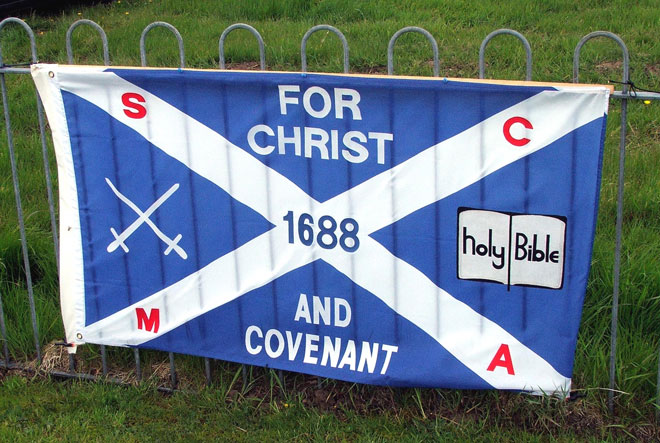
The battle flag was adapted from the flag of Scotland, which uses the cross of St. Andrew (that is, the "X" shape). More specifically, it comes from the flag of the Covenanters, a group of Scottish Presbyterians who were persecuted by Kings James, Charles I, Charles II, and James II, for resisting their efforts to bring the church into subjection to the government. That is what the battle flag represents: a refusal to bow to tyrants, because we must obey God rather than man (Acts 5:29). The war wasn't about slavery; it was about northern Unitarians and Deists, trying to crush the Calvinism that was still strong in the South, due to her large number of Scots and Scots-Irish immigrants, who did not own slaves! That was an English concept (including selling some of the Covenanters into slavery).

Some versions use red for the cross of St. Andrew.


I resent two things about the current uproar over the flag.

The first is its misappropriation by scum, nutbags, evil men, such as the man who killed those good folks in Charleston and the Ku Klux Klan. They have no concept of honor or heritage, but only of satanic hate. And I mean that literally: I believe that racial supremacists are inspired by Satan to bring chaos and violence into our society.

The second thing I resent is some folks on the other side who presume to define for me what my heritage stands for, and what symbols I will be allowed to show my heritage. That is a form of theft, and they would never allow me to do the same to them.

That is why I decided to write this post. I am telling both groups that I refuse to be defined by them. The Vth Commandment tells me to honor my father and my mother, and by implication all my ancestors. As long as I do not violate the rights of others - and there is no right not to be offended - I refuse to capitulate to efforts to take away my right and responsibility to honor my great-great-grandfather.

Wednesday, July 1, 2015

Pentecostals and the Pope: Reversing the Reformation

At a convention sponsored by the Kenneth Copeland Ministries, delegates were treated to a video from Pope Francis, in which he expressed his yearning, "Let’s give each other a spiritual embrace and let God complete the work that He has begun." The video can be watched on Youtube.

In the video, the Pope claims that the Catholic Church and Pentecostals share the blame for the separation between them. "It’s sin that has separated us, all our sins, the misunderstandings throughout history. It has been a long road of sins that we all shared in. Who is to blame? We all share the blame," he said. "We have all sinned. There is only one blameless, the Lord."

In response, Kenneth Copeland told the audience, "Come on, the man asked us to pray for him... Oh Father…we answer his request," Copeland prayed. "And since we know not how to pray for him as we ought other than to agree with him in his quest and his heart for the unity of the body of Christ… we come together in the unity of our faith, Halleluiah!"

Do you notice anything missing from the lovefest? I see no mention of the controversy between Rome and Protestants over such things as justification b y faith alone, the sufficiency of the scriptures alone, or the exclusive headship of Christ over His church. That is, neither Francis nor Copeland makes any mention of the reasons that Calvin, Luther, Cranmer, etc., were compelled by Scripture and their consciences to oppose the Papacy as a corruption of the Christian Faith.

That is hardly surprising. Afterall, Copeland and his ilk teach the same semi-Pelagian heresy that has always been taught by Rome. While Francis mumbles about sin on both sides, he sees no need to repent of his view of the Gospel, because these Pentecostals ( and others) aren't requiring him to move toward a biblical Gospel. Rather, they have been moving toward a papist Gospel of human ability, tradition over Scripture, subjectivism, and the blending of works with faith.

The Reformers labelled the Papacy as the Anti-Christ, and the Church of Rome as the great Whore of the Revelation. And in the five hundred years since, Rome hasn't changed anything but the window-dressing. Yet, she has managed to convince some self-described Protestants to de-Protestantize themselves, and return to her blasphemous bosom.

I for one say good riddance!

By no means should my comments here be taken to suggest that all Pentecostals share in the apostasy of these associates of Kenneth Copeland. However, I have yet to see their condemnation of these apostates.

God says, "Come out of her, My people, lest you take part in her sins, lest you share in her plagues" (Revelation 18:4).