Wednesday, May 31, 2017

How Important Is the Sabbath to God?


I am not here to prove the continuing ordinance of the Sabbath, or that it is now to be on the first day rather than the seventh. I have dealt with those topics elsewhere (use the "sabbath" tag at the bottom). Rather, today my purpose is to show the value that God places on the Sabbath, and how severely He opposes the trampling of it.

In Jeremiah 17:20-22, that prophet was given a message particularly for the royal family of Judah: "Hear the word of the Lord, you kings of Judah, and all Judah, and all the inhabitants of Jerusalem, who enter by these gates. Thus says the Lord: Take care for the sake of your lives, and do not bear a burden on the Sabbath day or bring it in by the gates of Jerusalem. And do not carry a burden out of your houses on the Sabbath or do any work, but keep the Sabbath day holy, as I commanded your fathers." I want particularly to point to Jeremiah's audience here, the royalty. Through him, God is making an argument from the greater to the lesser, or in Latin, argumentum a fortiori. That is, if even the royalty are under obligation from God to honor His Sabbath Day, then everyone else must logically also be under that obligation.

Then Jeremiah turns from who is obligated to that to which they are obligated, the rewards for obedience, and the curse for disobedience, a standard form of covenantal stipulations (Jeremiah 17:24-27): "If you listen to Me, declares the Lord, and bring in no burden by the gates of this city on the Sabbath day, but keep the Sabbath day holy and do no work on it, then there shall enter by the gates of this city kings and princes who sit on the throne of David, riding in chariots and on horses, they and their officials, the men of Judah and the inhabitants of Jerusalem. This city shall be inhabited forever, and people shall come from the cities of Judah and the places around Jerusalem, from the land of Benjamin, from the Shephelah, from the hill country, and from the Negeb, bringing burnt offerings and sacrifices, grain offerings and frankincense, and bringing thank offerings to the house of the Lord. But, if you do not listen to Me, to keep the Sabbath day holy, and not to bear a burden and enter by the gates of Jerusalem on the Sabbath day, then I will kindle a fire in its gates, and it shall devour the palaces of Jerusalem and shall not be quenched." Prosperity and safety are promised for obedience, while destruction is promised for disobedience. And, indeed, Judah was destroyed by the Babylonians in 586BC, so we already know the final result.

To use the language of teenagers, Jeremiah shows us that God don't play! Remember when Jesus called Himself the Lord of the Sabbath (Matthew 12:8)? People treat that as as a statement to the intent of, "Don't work about it." But no, it is just the opposite! As Jehovah incarnate, Christ is literally the Lord of the Sabbath. "Lord' is used in the Greek translation of the Old Testament where "Jehovah" appears in the Hebrew. Jesus is exactly the same Lord who is speaking in this prophecy of Jeremiah. Far from saying that it is unimportant, by declaring Himself Lord of the Sabbath, Jesus was telling His disciples that it was very important to Him!

Saturday, May 27, 2017

Regeneration and Repentance

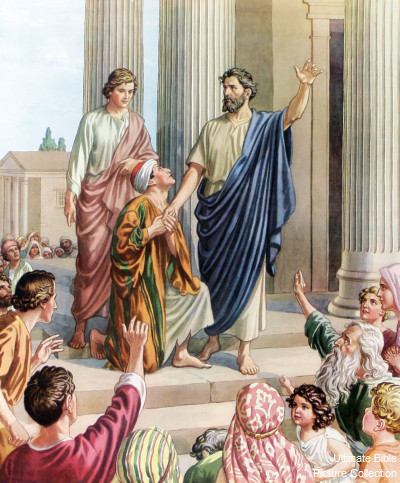
Peter on Solomon's Portico
In Acts 3:15-21, Luke gives us an account of a sermon to the Jews in front of the Temple. "You killed the Author of life, whom God raised from the dead. To this we are witnesses. And His name—by faith in His name—has made this man strong whom you see and know, and the faith that is through Jesus has given the man this perfect health in the presence of you all. And now, brothers, I know that you acted in ignorance, as did also your rulers. But what God foretold by the mouth of all the prophets, that His Christ would suffer, He thus fulfilled. Repent therefore, and turn back, that your sins may be blotted out, that times of refreshing may come from the presence of the Lord, and that He may send the Christ appointed for you, Jesus, whom heaven must receive until the time for restoring all the things about which God spoke by the mouth of His holy prophets long ago."

As God had planned (see Acts 4:27-28),  the Jews had rejected their Messiah and killed Him on the cross. This was God's purpose, to bring to pass the redemption of His church (Ephesians 5:25). But the perpetrators of that crime, the unbelieving Jews, had declared a curse upon themselves: "His blood be on us and on our children!" (Matthew 27:25). Yet, notwithstanding their self-cursing, Peter tells them how to escape the wrath of God: "Repent and turn back, that your sins may be blotted out" (Acts 3:19). And this was no new doctrine, for it was exactly what had been proclaimed in their Hebrew Scriptures: "Come now, let us reason together, says the LORD: though your sins are like scarlet, they shall be as white as snow; though they are red like crimson, they shall become like wool" (Isaiah 1:18).

Many people put an incorrect order to this. They suppose that an unregenerate man first repudiates his sin, and then believes in God, and then, finally, is justified. That, in fact, is impossible. The unregenerate man has no interest in forsaking sin or turning to God: "None is righteous, no, not one; no one understands; no one seeks for God" (Romans 3:10-11). First, God must work regeneration in the heart of that man (Ezekiel 36:26). Then, God gives Him faith to recognize a reconciled God in the redeeming blood of Jesus (Ephesians 2:8-9), by which means God then inspires him to repent of his sins (Acts 5:31 and II Timothy 2:25). Note that each step is by the initiation of God, never by man: "For those whom He foreknew He also predestined to be conformed to the image of His Son, in order that he might be the firstborn among many brothers. And those whom He predestined He also called, and those whom He called He also justified, and those whom He justified He also glorified" (Romans 8:29-30).

Peter's answer to the Jews was that they needed to repent. And being knowledgeable of their Old Testament Scriptures. they know what he meant. However, even Christians today are ignorant of the Scriptures, especially the Old testament, so we don't have a proper understanding of how it occurs. It is not something which one can do by working at it. Rather, it can only be something that God works in him: "I have heard Ephraim grieving, 'You have disciplined me, and I was disciplined, like an untrained calf; bring me back that I may be restored, for you are the Lord my God" (Jeremiah 31:18). See also Acts 5:31 and II Timothy 2:25. And it is something that He promises to do in His elect: "I, I am He who blots out your transgressions for my own sake, and I will not remember your sins" (Isaiah 43:25).

Wednesday, May 24, 2017

Christians and Astrology Mix Like Oil and Water

In my area, I will occasionally pass by houses with signs out front proclaiming "spiritual advisors," usually surrounded by symbols, such as crosses, palms, stars, crystals, etc. I also run into people online who boldly claim that they see no contradiction between a Christian profession and being, or consulting, an astrologer. After all, they proudly proclaim, God gave the stars as "signs" (Genesis 1:14).

Yet, somehow, they blank out what kind of signs (Genesis 1:14-15): "And God said, 'Let there be lights in the expanse of the heavens to separate the day from the night. And let them be for signs and for seasons, and for days and years, and let them be lights in the expanse of the heavens to give light upon the earth'" Notice that there is no divination mentioned here. No materialistic fatalism. Rather, the stars, sun, and moon are to give light and serve as signs of the calendar. How were pre-technological men to know when to plant their crops or move their livestock to seasonal pastures? By the seasons as marked by, not astrology, but by astronomy.

In fact, the Scriptures explicitly speak against astrology as a pagan practice (Jeremiah 10:2-3): "Learn not the way of the nations, nor be dismayed at the signs of the heavens because the nations are dismayed at them, for the customs of the peoples are vanity." Not just a pagan practice, a form of syncretism, but a vain pagan practice, i. e., one without benefit! I cannot but help to point to the example of Jacob and Esau. As twins, they were born under the same astrological circumstances. Yet, as their history demonstrates, they became very different men, and their lives had very different paths and outcomes.

If the stars didn't produce the different lives these two men lived, what did? The Bible, not the stars, gives the answer: "Though they were not yet born and had done nothing either good or bad—in order that God’s purpose of election might continue, not because of works but because of Him who calls— she was told, 'The older will serve the younger.' As it is written, 'Jacob I loved, but Esau I hated'" (Romans 9:11-13). What made the difference was election, God's sovereign grace, which chose Jacob but not Esau. Do you see? It isn't the stars that determine our fate, but God!

That is why astrology, no matter how baptized with Christian symbols or terminology, can never be compatible with the Christian faith. They are based on mutually-exclusive worldviews, one a form of materialistic fatalism, the other on an unreservedly sovereign God. If the stars are in control, then God is not. If God is in control, not only are the stars not, but rather they are the servants of His purposes of goodness (Matthew 5:45).


Monday, May 22, 2017

Must a Man Be Saved? Or Does He Get Saved?

At first glance, my title above might seem to be making a distinction without a difference. Isn't being saved the same thing as getting saved, you are probably asking.

And the answer is, No, those two things are diametrically opposed!

The Arminian betrays his Pelagian roots by claiming that the unregenerate man, every unregenerate man, starts with enough spiritual light to seek God, resulting in God's rewarding him with grace to continue that process, until he finally attains justification. In other words, the Arminian disagrees with Paul's statement in Ephesians 2:1: "You were dead in the trespasses and sins." No, he says, as Pelagius did, the unregenerate man is merely sick in trespasses and sins, not dead.

Of course, that verse is not the only one that tells us of the helplessness of the unregenerate heart. Paul also tells us, in Romans 3:10-12, "None is righteous, no, not one; no one understands; no one seeks for God. All have turned aside; together they have become worthless; no one does good, not even one." 

The Arminian hates that portrayal of the natural man, because, he wrongly believes, that leaves man with no hope of salvation. His attitude is that of the disciples who witnessed the interaction between Jesus and the rich young ruler ( Matthew 19:16-26). After the ruler leaves them, Jesus says to the disciples, "I tell you, it is easier for a camel to go through the eye of a needle than for a rich person to enter the kingdom of God" (verse 24). And the disciples reply as the good Arminians they were, "Who then can be saved?" (verse 25). If such a man cannot save himself, then salvation must be impossible. And Jesus agrees, that salvation on that basis would, indeed, be impossible: "With man this is impossible." However, that is not how salvation occurs: "With God all things are possible" (verse 26). In other words, Arminian salvation is impossible. But, praise God, he does not leave us hopeless in an Arminian universe.

As He promised His people through Moses, "The Lord your God will circumcise your heart and the heart of your offspring, so that you will love the Lord your God with all your heart and with all your soul, that you may live" (Deuteronomy 30:6). The preincarnate Christ said the same thing to Moses that the incarnate Christ said to His disciples: "With God all things are possible," including the salvation of hopeless sinners. "God shows his love for us in that while we were still sinners, Christ died for us" (Romans 5:8).

Saturday, May 20, 2017

Under Grace, Not Under Law

After John 3:16, Romans 6:14 is probably the most-quoted verse in the Bible: "You are not under law but under grace." Quoted, but certainly not understood.

Paul frequently had to deal with judaizers, heretics who tried to convince Gentile converts to Christ that they had to perform the Jewish ceremonies to be really saved. Note that I deliberately refer to them as heretics, because such a teaching was opposed to the doctrine of justification taught by all of Scripture, including in the words of Jesus Himself.

It is this historical context that the verse above must be considered. Paul was addressing a life-or-death struggle over the very nature of salvation, and his insistence was well-justified: if any man, under either testament, was, or could be, saved by performing the Law of Moses, then Jesus suffered and died in vain. The saved man could properly point to himself, his own deeds, and his own moral superiority as the basis of his right to eternal life. "If Abraham was justified by works, he has something to boast about" (Romans 4:2). But God had already said that He would never allow any mere man to take credit for His acts: "For My own sake, for My own sake, I do it, for how should My name be profaned? My glory I will not give to another" (Isaiah 48:11, see also Is. 42:8). Rather, He says, "Let the one who boasts, boast in the Lord" (I Corinthians 1:31). Why? Because, "Then what becomes of our boasting? It is excluded. By what kind of law? By a law of works? No, but by the law of faith" (Romans 3:27). If the actions of a man contribute to his justification, then he can claim credit for himself, even if he says that it just partial. God,
however, insists that it is all by Him, zero by us.

And that brings us back to Romans 6:14: "You are not under law but under grace." Paul cannot be saying that a Christian should, or even can, reject God's Law. Rather, he is saying that the Christian must reject the Law as a source of salvation. If it were more than that, then he could not have already said, "Do we then overthrow the law by this faith? By no means! On the contrary, we uphold the law" (Romans 3:31). Moreover, he wasn't even making a fresh claim, as if no one had ever known that they could not be saved by the Law. That had always been true! 

Look at the new covenant that God promised to Israel: "Behold, the days are coming, declares the Lord, when I will make a new covenant with the house of Israel and the house of Judah, [and] this is the covenant that I will make with the house of Israel after those days, declares the Lord: I will put My law within them, and I will write it on their hearts. And I will be their God, and they shall be My people" (Jeremiah 31:31, 33). It is the renewed giving of His Law that God promises! "This is for Israel," someone might object. However, this exact promise is quoted for us by the author of Hebrews 8:10!

Scripture gives us good reason to reject any thought of justification before God by obeying His commandments. However, it is just as firm in denying that any saved man can despise God's Law while claiming to love the Law's God: "If you love Me, you will keep My commandments" (John 14:15).

Wednesday, May 17, 2017

Pro-Life: The Relationship Between Abortion and Capital Punishment

Moses records some very important words of God in Numbers 35:31-33: "You shall accept no ransom for the life of a murderer, who is guilty of death, but he shall be put to death. And you shall accept no ransom for him who has fled to his city of refuge, that he may return to dwell in the land before the death of the high priest. You shall not pollute the land in which you live, for blood pollutes the land, and no atonement can be made for the land for the blood that is shed in it, except by the blood of the one who shed it."

As can be seen elsewhere (such as here) on this website, I am outspokenly pro-life. That is, opposed to abortion. I have been told by some on the evangelical left that I must also be opposed to capital punishment in order to be consistently pro-life. I deny that assertion, because it fails to consider the necessary distinction
between guilty and innocent life. A preborn child cannot have ever caused any harm to another human being. A criminal on death row, however, is there exactly because he has committed some heinous act against at least one other human being.

Why is that so significant? Because God says that we are made in His image (Genesis 1:27), and to attack His image is to attack Him:"Whoever sheds the blood of man, by man shall his blood be shed, for God made man in His own image" (Genesis 9:6). that has two implications. First, anyone who commits murder has killed the image of God, and He takes that very personally. And second, the perpetrator, who is also an image bearer, must be treated with the moral character that this truth carries. Not only has he committed a heinous act against the image of God, but he has perpetrated an incomparable act of treason as the image of God. And logically, God says, only the taking of his blood, as he has taken blood, is proportionate both to the crime and to the criminal.


Saturday, May 13, 2017

The Hermeneutics of "Law" in the Bible


I often hear people refer to biblical Law in ways which are so obtuse that I wish I could unhear them. That is a gift, which God has, so far, not seen fit to grant me.

On one hand, I have Catholics and Mormons who deny justification by grace through faith alone by insisting that the works which are excluded by Paul refer not to all works, but rather only those involving the ceremonial law of Moses. "For by works of the law no human being will be justified in His sight, since through the law comes knowledge of sin" (Romans 3:20). And it is certainly true that the Old Testament sacrifices were according to Law. 

On the opposite extreme, I am frequently confronted by dispensationalists who parrot "you are not under law but under grace" (Romans 6:14) over and over if I say anything favorable about God's Law.

Of course, both views are unbiblical. One is an effort to sustain a works righteousness by which the believer cooperates in his own justification. The other is bald-faced antinomianism, a false view that the free grace of God means that a person can be a true believer no matter how he lives. Unbiblical and false!

The error of both sides described above is the result of equivocation. They take one particular meaning of the word "law" and use it in a different context. It is as if I said, "John is from Jamaica," and you take it to mean the island of Jamaica, when I actually meant that he is from the city of Jamaica, New York.

The word "law ("torah" in Hebrew or "nomos" in Greek) has eight different meanings in Scripture:
1) law of nature (Rom. 2:14-15)
2) the corruption of human nature (Rom. 7:23)
3) the entire word of God (Ps. 19:7-8)
4) the books of Moses (Luke 24:44)
5) the gospel (Rom. 3:27, Isa. 2:3)
6) the civil laws (John 19:7)
7) the ceremonial laws (Heb. 10:1)
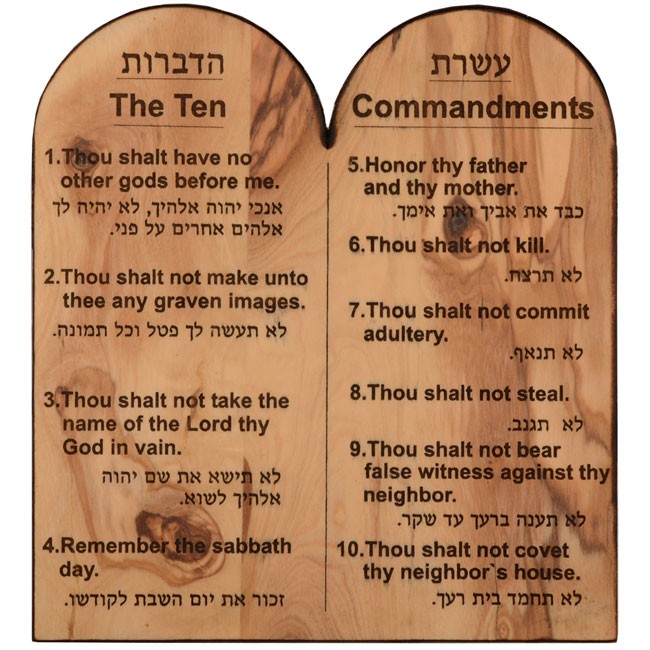
8) moral law, especially the Ten Commandments (Matt. 22:36-38)

When Paul tells us that justification by faith necessarily excludes any works of the Law, he cannot be referring to the works of the Mosaic ceremonies, i. e., number 7 above, because very few of them were performed by the individual believer; it was only the priests that performed, for example, the sacrifices. And, since those ceremonies ended with the destruction of the Temple in 70AD, it would be a tautology to say that we are not justified by those same ceremonies.

Also, when Paul says that "we are under grace, not under law," he cannot mean that we have no obligation to the moral Law of God (number 8 above), because those two things are directed to different ends. Grace is the application of the merits of Christ to the elect. it is how we are justified. The moral Law, however, as that name implies, is a matter of how to live. One cannot be brought to life by a rule of life. That can only be done by grace. Once grace has brought new life, the Law then tells the believer how to live that life. It's like a car loan. That loan is the means for attaining a new car. However, the car loan is not the means for driving the car. It takes a manual to do that. The loan is the grace, the manual is the Law. They are not in opposition, as long as neither is used in place of the other.

We see this described vividly in Ezekiel 36:26-27: "I will give you a new heart, and a new spirit I will put within you. And I will remove the heart of stone from your flesh and give you a heart of flesh. And I will put My Spirit within you, and cause you to walk in My statutes and be careful to obey My rules. You shall dwell in the land that I gave to your fathers, and you shall be My people, and I will be your God." The new heart, a biblical image of justification, is God's gracious act, in which the new believer makes no contribution. That is grace. The effect of this new heart is that he is now enabled to obey God's Law (not perfectly, but progressively in this life). That is sanctification.