Sunday, October 28, 2012

Muslim Insecurity Leads to Self-Destructive Riots

We have all seen the news stories: maddened crowds burning, chanting, screaming, even killing. Why? Because they were offended by a privately-made film which ridicules their prophet. That is the reality in Muslim-dominated countries. Where the peaceful debate over ideas is commonplace, and taken for granted, in countries with a Christian tradition (notice that I am not saying that they are Christian), in Muslim countries the free exchange of ideas certainly does not take place. Rather, in those countries, disagreement with majority views is suppressed with violence, both by government and by private individuals or groups. These riots have hit Arab countries, Pakistan, Muslim immigrant communities in Europe, and around the world. Where Muslims have free access to the media, and may publish their views, even critical of governments or other religions, reciprocal freedoms certainly are not found in Muslim-majority countries. Those who refuse to accept Islam face persecution, arson, rape, even murder. To my mind, there could be no more-eloquent proof that the faith of Muslims is indefensible, because their religion originated in the mind of a madman, not God.

Sunday, October 21, 2012

John Knox on Temptation

"Then Jesus was led up by the Spirit into the wilderness to be tempted by the devil." This verse begins the description of the Temptation of Christ, found in Matthew 4:1-11.

 In a sermon on this passage, the Scottish Reformer John Knox left us some comforting remarks on the question of temptation of ourselves. Knox taught that God sends temptations "to open and make manifest the secret motions of men's hearts, the puissance and power of God's Word, and the great lenity [leniency] and gentleness of God towards the infirmities , the horrible sins, and rebellions of those whom he hath received into His regiment and care." Thus, he held that temptations have three purposes in the intentions of God.

 First, they reveal, on one hand, the true character of the believer, bringing up his strengths, weaknesses, self-deceptions, unrecognized motivations, and ignorance. Second, they confirm the accuracy, power, and effectiveness of scripture. And third, they reveal the mercy and leniency of God toward our failures. I find great sweetness in those thoughts.

Some would object with James 1:13, "Let no one say when he is tempted, 'I am being tempted by God,' for God cannot be tempted with evil, and he himself tempts no one." Knox addresses this verse. He held that James wasn't speaking in an absolute sense, i.e., that God never sends any temptation to any person at any time. Rather, he understood James to mean that God doesn't send temptation with the evil intentions that Satan does. I think Knox's interpretation is supported by the account of the temptation of Job, such as Job 1:11 and 2:5. In those verses, we see Satan intending to undermine Job's faith. In contrast, in allowing Satan's efforts, God expects, rightly, as we later see, to be glorified.

Sunday, October 14, 2012

"Jesus's Wife," the Desperation of Unbelief

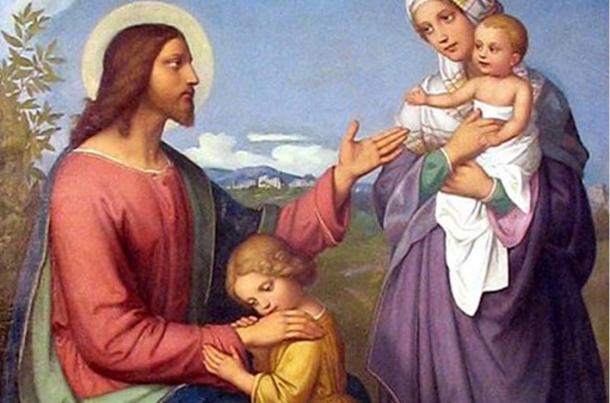
Images like the one above were all over the news for a while, with commentary about a fragment which supposedly proved that Jesus was married. The fragment was in Coptic, not even a Palestinian language. However, it had been discovered by a professor from the Harvard Divinity School, so that covered all of its inadequacies. That professor dated the fragment to the second half of the second century, that is, more than a century after the time of Christ's life on earth. Yet, it was given the credence that such scholars do not give the gospels written by the eyewitnesses of His life.

 I have found the hype around this story to be quite entertaining. Secular scholars and heterodox religious scholars trip over themselves to find evidence that supposedly upends the Bible. Yet, they are invariably embarrassed in their efforts.

 For one thing, one very large thing, it is well-known that the Bible speaks of the bride of Christ. For example, in II Corinthians 11:2, the Apostle Paul describes the Church at Corinth as a bride betrothed to Christ. And in Revelation 19:6-9, the Apostle John describes a wedding feast for Christ and His bride, the glorified Church. In other words, true Christianity holds that Jesus does have a wife, but this is a metaphor for His relationship to the Church. Thus, even if the fragment is legitimate, it doesn't necessarily teach anything that orthodox Christians don't already hold.

 However, once the fragment became public, evidence of its counterfeit derivation started to leak out. The Vatican and Baptist authorities quickly dismissed it, as would be expected. However, secular authorities also started to question it, and even the liberal Huffington Post. I believe all of this proves what Paul also says, in Romans 1:21-22, "For although they knew God, they did not honor him as God or give thanks to him, but they became futile in their thinking, and their foolish hearts were darkened. Claiming to be wise, they became fools..."

Wednesday, July 11, 2012

Christ's High-Priestly Prayer: Unity, Yes, but with Whom?

"I do not ask for these only, but also for those who will believe in Me through their word, that they may all be one, just as You, Father, are in Me, and I in You, that they also may be in Us, so that the world may believe that You have sent Me. The glory that You have given Me I have given to them, that they may be one even as We are one, I in them and You in Me, that they may become perfectly one, so that the world may know that You sent Me and loved them even as You loved Me."
- John 17:20-23

In this passage, part of what is commonly called Jesus's High-Priestly Prayer, the Redeemer asks His Father to bring unity among Christians. Thus, to desire unity among believers is a godly and biblical desire. But then practical questions begin: with whom am I to have unity? How am I to bring about biblical unity? The problem comes because this isn't the only passage relevant to the question of unity. 

In both Testaments, we can find repeated warnings that God expects His true people to be discerning regarding our allies. Leviticus 10:10, "You are to distinguish between the holy and the common, and between the unclean and the clean..." Leviticus 20:25-26, "You shall therefore separate the clean beast from the unclean, and the unclean bird from the clean. You shall not make yourselves detestable by beast or by bird or by anything with which the ground crawls, which I have set apart for you to hold unclean. You shall be holy to Me, for I the LORD am holy and have separated you from the peoples, that you should be Mine." Ezekiel 44:23 (speaking of the clergy), "They shall teach My people the difference between the holy and the common, and show them how to distinguish between the unclean and the clean." II Corinthians 6:17, "Therefore go out from their midst, and be separate from them, says the Lord, and touch no unclean thing; then I will welcome you..." James 4:4, "You adulterous people! Do you not know that friendship with the world is enmity with God? Therefore whoever wishes to be a friend of the world makes himself an enemy of God." Revelation 18:4, "Then I heard another voice from heaven saying, 'Come out of her, my people, lest you take part in her sins, lest you share in her plagues...'" This last verse is especially applicable to my purpose in writing this, because it explicitly commands separation from the false church. Here in my local area, the Rev. Robert Austell, of Good Shepherd Presbyterian Church (PCUSA), a self-described "conservative evangelical," declared his candidacy for moderator of their general assembly.
.
In a presbyterian church, the moderator acts as chairman of the meeting, and the office is usually voted on at the beginning of the meeting, or annually, depending on the level of the court. In the election, Rev. Austell came in third of the four candidates. According to the article in our local newspaper, "while many congregations who share his theological views have left Presbyterian Church (USA), he and Good Shepherd are staying put. In a time of culture wars and deepening spiritual divides, Austell hopes to unite." 

The reporter is correct: many evangelical congregations have fled the PCUSA for more-conservative pastures, mainly in the PCA, but also the Evangelical Presbyterian Church and the Associate Reformed Presbyterian Church, not to mention the new breakaway group, the Covenant Order. In 1982, the then-United Presbyterian Church (which merged the next year with the Southern Presbyterian Church to form the current PCUSA), ordained Mansfield Kaseman to the ministry, though he denied during his examination both the deity of Christ and the resurrection of the body. The inerrancy of the Scriptures is almost-universally denied by PCUSA officers. In 1923, J. Gresham Machen, then a minister in the northern Presbyterian Church, in his book Christianity and Liberalism, demonstrated that liberalism is not a version or interpretation of Christianity, nor even related to Christianity, but is rather a completely different type of religion from Christianity. Yet, this is what Austell wants to be united with. 

I want to ask him this question: how does the unity you seek line up with the Scriptures (see above)? To my mind, that is the only legitimate standard of judgment. And again to my mind, Austell's desire fails to match that standard.

Sunday, April 15, 2012

The Testimony of the Bible to Its Own Infallibility


"Question 157: How is the Word of God to be read?
Answer: The holy Scriptures are to be read with an high and reverent esteem of them; with a firm persuasion that they are the very Word of God, and that he only can enable us to understand them; with desire to know, believe, and obey the will of God revealed in them; with diligence, and attention to the matter and scope of them; with meditation, application, self-denial, and prayer."
- Westminster Larger Catechism, Q&A 157

As a Presbyterian, I resent the association, in the minds of many, of me (and my fellow churchfolk) with the liberal Presbyterian Church (USA). That denomination is just one of the Presbyterian churches in this country, and in no way represents historical Presbyterianism. The question above comes from the Westminster Larger Catechism, one of the traditional doctrinal documents that Presbyterians have professed ever since 1647. As can be seen, it describes a proper Christian understanding that the Scriptures are the very word of God, and must be received and honored as such by the true Christian. The Catechism reflects what the Scriptures testify of themselves.

Isaiah 55:11:, "[S]o shall my word be that goes out from My mouth; it shall not return to Me empty, but it shall accomplish that which I purpose, and shall succeed in the thing for which I sent it." God acknowledges the Scriptures as His own word, and promises their spiritual effectiveness.

Jeremiah 23:29: "Is not My word like fire, declares the LORD, and like a hammer that breaks the rock in pieces?" The Word overcomes all resistance.

II Timothy 3:16-17: "All Scripture is breathed out by God and profitable for teaching, for reproof, for correction, and for training in righteousness, that the man of God may be competent, equipped for every good work." This is the central proof-text. The Scriptures are inerrant, because their divine Author is necessarily infallible!

II Peter 1:21: "For no prophecy was ever produced by the will of man, but men spoke from God as they were carried along by the Holy Spirit." Another powerful text, because of its simple and direct message. While the Bible certainly was written by human authors, it is not their word, but that of the Holy Spirit who moved them is such a way as to record His words.

Hebrews 4:12: "For the word of God is living and active, sharper than any two-edged sword, piercing to the division of soul and of spirit, of joints and of marrow, and discerning the thoughts and intentions of the heart." In a parallel to the Isaiah reference, the writer of Hebrews testifies to the power of the Scriptures to effect us in fundamental ways.

As you can see the Catechism correctly summarizes the very testimony that God gives to His own word. Those who deny the inerrancy of the Bible, yet claim to be Christians face this warning from Jesus Himself (John 14:28): "The one who rejects Me and does not receive My words has a judge; the word that I have spoken will judge him on the last day." To reject the Scriptures is to reject Christ, and that choice will be recalled as evidence against you in the Judgment to come.

Thursday, April 5, 2012

Romans 4:1-8, the New American Gospel of Legalism

"What then shall we say was gained by Abraham, our forefather according to the flesh? For if Abraham was justified by works, he has something to boast about, but not before God. For what does the Scripture say? 'Abraham believed God, and it was counted to him as righteousness.' Now to the one who works, his wages are not counted as a gift but as his due. And to the one who does not work but believes in Him who justifies the ungodly, his faith is counted as righteousness, just as David also speaks of the blessing of the one to whom God counts righteousness apart from works: 'Blessed are those whose lawless deeds are forgiven, and whose sins are covered; blessed is the man against whom the Lord will not count his sin.'"

Part of the background of my church is the Associate Presbytery of Scotland, usually called by their nickname of "Seceders." I have studied them extensively, both because of that historical connection and because of the spiritual issues involved in their secession from the established Church of Scotland. I especially concentrate on the issues of that division which we see arising again in our modern time.

I won't go into the complex of issues that led to the secession. Rather, I want to address the one issue of neonomianism. Neonomianism is the teaching, not usually explicitly stated, that the Gospel is a form of Law ("neo" new+ "nomos" law), such that a person is not saved by acts of the Mosaic law, but rather through a new form of merit through repentance and works of new obedience.

The dominant party in the Church of Scotland General Assembly held that the recipient of the Gospel had to go through several steps of preparation, through sorrow and repentance of sin and moral reformation. In opposition to these forms of merit, the Seceders, centered around a book called The Marrow of Modern Divinity, held to a Gospel of free grace. They insisted that all of the merit in the Gospel is in Christ alone, by grace alone, received by faith alone. In other words, they were defending the same solas that led to the Protestant Reformation two hundred years earlier.

The reason that I refer to this as the "New American Gospel of Legalism" is that the same errors that destroyed the Church of Scotland have become the doctrine of mainstream American Evangelicals. Even in the psychobabble that has become part of our daily conversation, "Just have faith," arises from this error. "Faith" has become the new works-righteousness. We supposedly merit salvation by having enough faith. This is even made explicit by the prosperity preachers. But isn't it what most people expect? "If I just believe hard enough, God has to give me what I want and take me to heaven."

However, notice what Paul says above about Abraham: "Abraham believed God." He doesn't say, "Abraham believed in God." Everyone believes in God, even if he doesn't admit it (Romans 1:18-21). James 2:19 says that even the demons believe in God! That puts the spiritual commitment of most Americans on par with that of demons!

But Abraham didn't just believe in God. He believed God, that is, he believed the promises of God. Go to Romans 4:20-25, "No distrust made him waver concerning the promise of God, but he grew strong in his faith as he gave glory to God, fully convinced that God was able to do what He had promised. That is why his faith was 'counted to him as righteousness.' But the words 'it was counted to him' were not written for his sake alone, but for ours also. It will be counted to us who believe in Him Who raised from the dead Jesus our Lord, Who was delivered up for our trespasses and raised for our justification."

That is to say, our faith doesn't earn us salvation (or blessings). Our repentance doesn't earn us salvation. Our reformation of our lives doesn't earn us salvation. The only thing that earns our salvation is the finished work of Christ in His crucifixion and resurrection. That sole merit is then applied to us by means of faith.

The biblical order is Christ, then justification, then faith, then repentance, and with all resulting in sanctification. Any other order requires the hearer to act upon a person and work that he doesn't yet believe in. Logic alone should convince us that is impossible!

Thursday, March 15, 2012

The Sabbath and Going Out for Lunch after Church

Question 117: How is the sabbath or the Lord's day to be sanctified?
Answer: The sabbath or Lord's day is to be sanctified by an holy resting all the day, not only from such works as are at all times sinful, but even from such worldly employments and recreations as are on other days lawful; and making it our delight to spend the whole time (except so much of it as is to betaken up in works of necessity and mercy) in the public and private exercises of God's worship: and, to that end, we are to prepare our hearts, and with such foresight, diligence, and moderation, to dispose and seasonably dispatch our worldly business, that we may be the more free and fit for the duties of that day.
- Westminster Larger Catechism 

At a former church, it was our practice all to go to lunch together after Sunday worship. It was a very small church, only about a dozen members, and we were widely dispersed, so participation was necessary if I were to have any sort of  relationships with my brethren. Doing that caused me great discomfort of conscience, because I believe that a Christian should avoid commercial activity on the Lord's Day. As the IVth Commandment says, we are not only to rest from our own labors, but also to relieve our servants of theirs. I am glad to say that my current situation doesn't put me in that conflict.

Some excuse eating out on Sundays as giving the wife the opportunity to rest. I think that is a good concern. However, I cannot accept that one person honors the Day by putting the work off on someone else.

Consider the Commandment itself (Exodus 20:10), "the seventh day is a Sabbath to the Lord your God. On it you shall not do any work, you, or your son, or your daughter, your male servant, or your female servant, or your livestock, or the sojourner who is within your gates." It is forbidden even to put the labor off onto one's employees or animals. I have seen this described as the first labor legislation.

Nehemiah expands this even further. Nehemiah 10:31 tells us, "if the peoples of the land bring in goods or any grain on the Sabbath day to sell, we will not buy from them on the Sabbath or on a holy day. And we will forego the crops of the seventh year and the exaction of every debt." And Neh. 13:15, "In those days I saw in Judah people treading winepresses on the Sabbath, and bringing in heaps of grain and loading them on donkeys, and also wine, grapes, figs, and all kinds of loads, which they brought into Jerusalem on the Sabbath day. And I warned them on the day when they sold food." Both of these verses describe people who willingly profit from providing Lord's Day labor to resting believers. Yet, this voluntary labor is still forbidden. And this is exactly what is happening when believers "honor" the Lord's Day by going to commercial establishments, where others profit from violating the Fourth Commandment.

Where I live, restaurants are swamped on Sunday afternoons. I sincerely believe that this grieves the Lord.